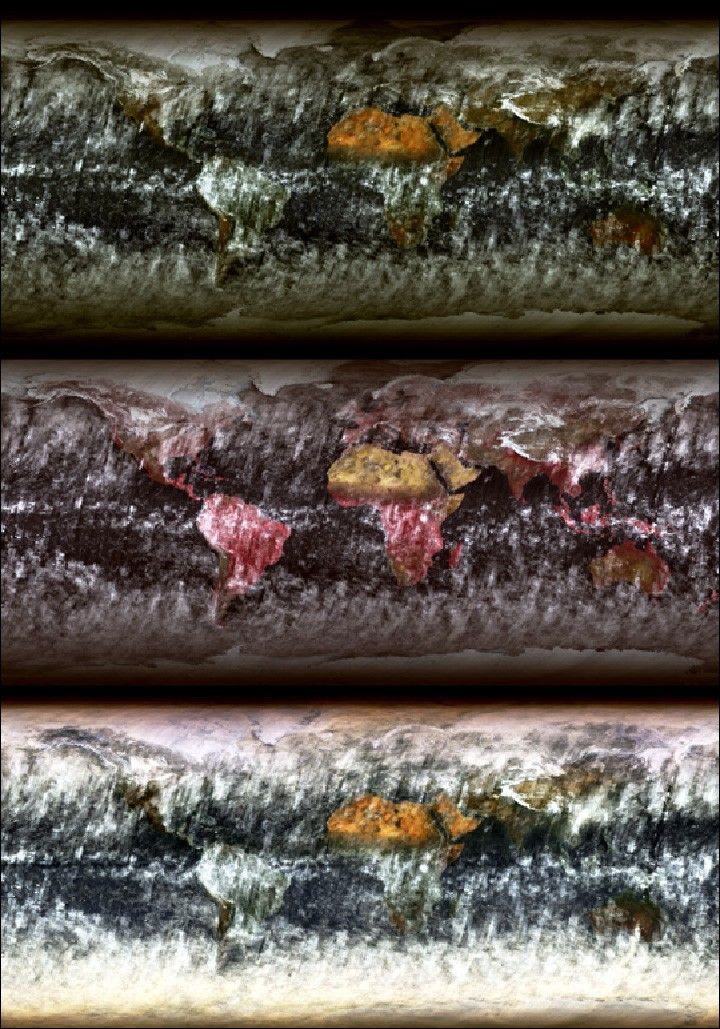
















As of July 31, 2002, global multi-angle, multi-spectral radiance products areavailable from the Multi-angle Imaging SpectroRadiometer (MISR) instrumentaboard the Terra satellite. Measuring theradiative properties of different types of surfaces, clouds and atmosphericparticulates is an important step toward understanding the Earth’s climatesystem. These images are among the first planet-wide summary views to bepublicly released from the MISR experiment.Data for these images were collected during the month of March 2002, and eachpixel represents monthly-averaged daylight radiances from an area measuring 1/2degree in latitude by 1/2 degree in longitude.
The top panel is from MISR’s nadir (vertical-viewing) camera and combinesdata from the red, green, and blue spectral bands to create a natural colorimage. The central view combines near-infrared, red, and green spectral data tocreate a false-color rendition that enhances highly vegetated terrain. It takes9 days for MISR to view the entire globe, and only areas within 8 degrees oflatitude of the north and south poles are not observed due to the Terra orbitinclination. Because a single pole-to-pole swath of MISR data is just 400kilometers wide, multiple swaths must be mosaicked to create these global views.Discontinuities appear in some cloud patterns as a consequence of changes incloud cover from one day to another.
The lower panel is a composite in which red, green, and blue radiances fromMISR’s 70-degree forward-viewing camera are displayed in the northernhemisphere, and radiances from the 70-degree backward-viewing camera aredisplayed in the southern hemisphere. At the March equinox (spring in thenorthern hemisphere, autumn in the southern hemisphere), the Sun is near theequator. Therefore, both oblique angles are observing the Earth in “forwardscattering”, particularly at high latitudes. Forward scattering occurs when you(or MISR) observe an object with the Sun at a point in the sky that is in frontof you. Relative to the nadir view, this geometry accentuates the appearance ofpolar clouds, and can even reveal clouds that are invisible in the nadirdirection. In relatively clear ocean areas, the oblique-angle composite isgenerally brighter than its nadir counterpart due to enhanced reflection oflight by atmospheric particulates.
References & Resources
Image courtesy NASA/GSFC/LaRC/JPL, MISR Team.