










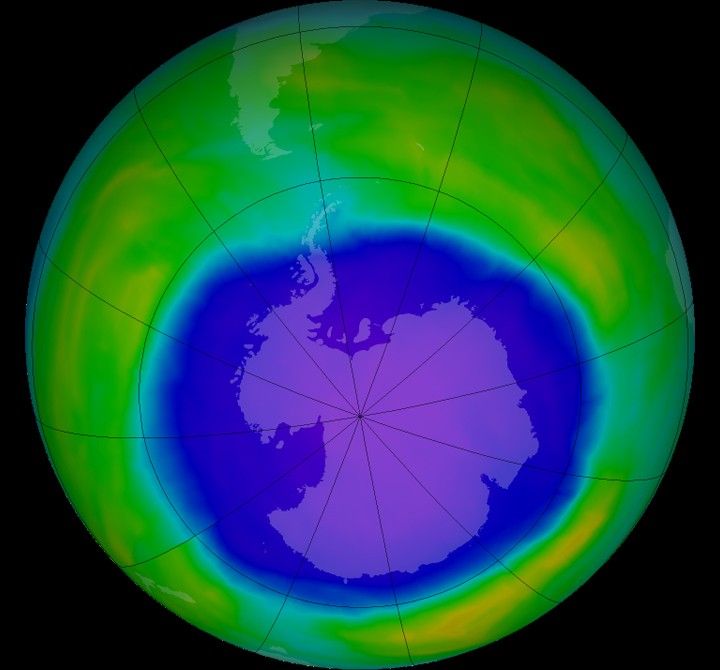
The ozone hole over Antarctica grew relatively large in 2015, according to data acquired by the Ozone Monitoring Instrument (OMI) on NASA’s Aura satellite and the Ozone Monitoring and Profiler Suite (OMPS) on the NASA-NOAA Suomi NPP satellite.
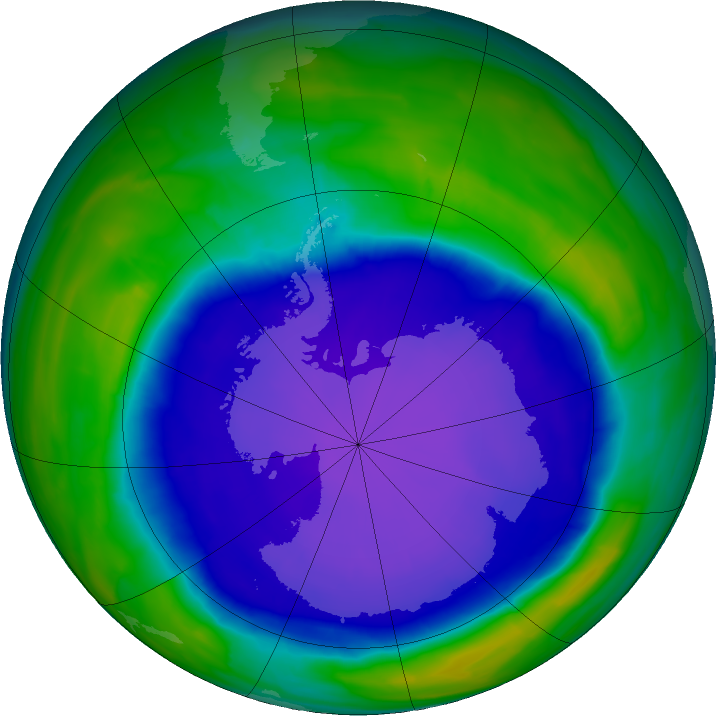
On October 2, 2015, OMI observed that the hole had reached its largest single-day area for the year. The image above, based on data acquired with OMI, shows the hole on that day. It spanned 28.2 million square kilometers (10.9 million square miles)—the fourth-largest area measured since the start of the satellite record in 1979. The largest single-day ozone hole recorded by satellite was 29.9 million square kilometers (11.5 million square miles) on September 9, 2000.
The ozone “hole” is not literally a hole; rather, the phenomenon is defined as the area where the concentration of ozone drops below the historical threshold of 220 Dobson Units. In the image above, those areas are purple and blue.
The ozone depletion phenomenon is seasonal, starting each year during the Antarctic spring and peaking between mid-September and early October. In 2015, the hole started slowly but then quickly expanded to cover a large area. The average size in September–October 2015 was 25.6 million square kilometers (9.9 million square miles)—also the fourth largest since the start of the satellite record. The largest September–October average on record was 26.6 million square kilometers (10.3 million square miles) in 2006.
In 2015, ozone concentrations also plunged lower than in recent years. On October 4, ozone reached an annual minimum concentration of 101 Dobson Units.
While the ozone hole area was large in 2015, the size was consistent with what scientists know about ozone depletion and chemistry. According to NASA atmospheric scientist Paul Newman, there are still plenty of ozone-depleting chlorine and bromine compounds present in the stratosphere. Moreover, the lower stratosphere was colder than in previous years, which creates favorable conditions for ozone-depleting chemical reactions.
Visit World of Change: Antarctic Ozone Hole to see how the holes have evolved since 1979.
References & Resources
- NASA Earth Observatory (2015) World of Change: Antarctic Ozone Hole.
- NASA Goddard (2015, October 23) Ozone Hole Watch. Accessed October 26, 2015.
- NASA Goddard (2015, October 22) NASA Study Shows That Common Coolants Contribute to Ozone Depletion. Accessed October 26, 2015.
- NASA Goddard (2015, October 7) 2015 Antarctic Ozone Hole Area Approaches Annual Maximum. Accessed October 26, 2015.
- Ozone Monitoring and Profiler Suite blog (2015, October 11) The Ozone Hole for 2015. Accessed October 26, 2015.
NASA images from Ozone Hole Watch. Caption by Kathryn Hansen.