












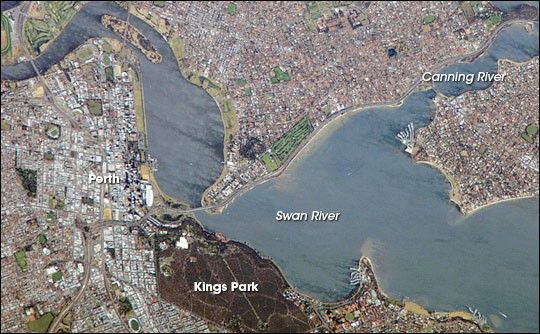
Perth is the capital of the state of Western Australia, and it is the largest city of the southwestern part of the continent, with an estimated population of over 1.5 million (as of December 2006). The downtown area of Perth and the surrounding suburbs are located on flood plain deposits of the Swan and Canning Rivers, which flow through the center of the metropolitan area. Perth enjoys a Mediterranean climate, where the summers are hot and dry, and winters are cool and moist. Wildfires can develop during the summer months; several large fires threatened the eastern portion of the metropolitan area in 2005.
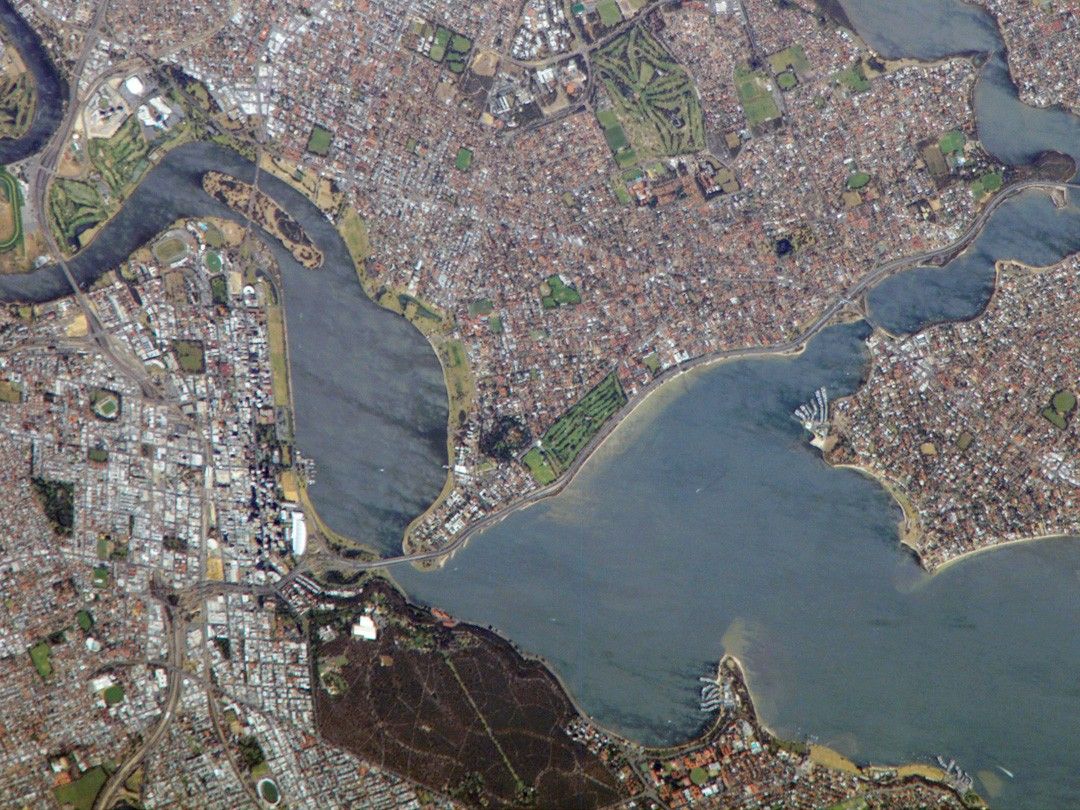
This astronaut photograph captures variations in urban land cover around Perth. The downtown center of the city (image left) is characterized by large buildings (such as skyscrapers) with white, reflective rooftops. Suburbs to the south (across the Swan River) are characterized by higher density of small buildings with predominantly reddish-purple roofs. Several areas of green vegetation are visible in the image. Parks and golf courses comprised mainly of grass present an even, green coloration, while the dense tree canopy of Kings Park appears dark green. Variations in the color of the Swan and Canning Rivers is due to sunglint, or light reflected off the water surface directly back to the observer (in this case, an astronaut about the International Space Station) like a mirror.
References & Resources
Astronaut photograph ISS016-E-22772 was acquired on January 11, 2008, with a Kodak 760C digital camera fitted with an 800 mm lens, and is provided by the ISS Crew Earth Observations experiment. The image was taken by the Expedition 16 crew and is provided by the Image Science & Analysis Laboratory, Johnson Space Center. The image in this article has been cropped and enhanced to improve contrast. Lens artifacts have been removed. The International Space Station Program supports the laboratory to help astronauts take pictures of Earth that will be of the greatest value to scientists and the public, and to make those images freely available on the Internet. Additional images taken by astronauts and cosmonauts can be viewed at the NASA/JSC Gateway to Astronaut Photography of Earth. Caption by William L. Stefanov, NASA-JSC.