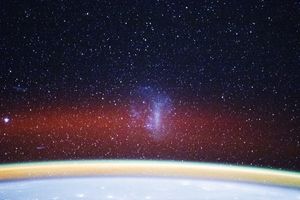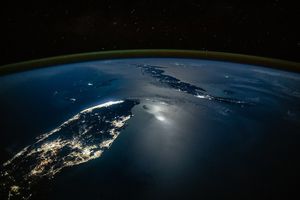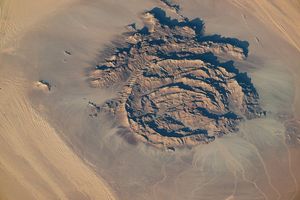





















If Iris, the goddess of the rainbow, had a sister she would be the goddess of Aurora. Glowing green ripples form arcs that constantly transform their shape into new glowing diaphanous forms. There is nothing static about auroras. They are always moving, always changing, and like snowflakes, each display is different from the last. Sometimes, there is a faint touch of red layered above the green. There are bright spots within the arcs that come and go, and transform into upward directed rays topped by feathery red structures. Sometimes there will be six or more rays, sometimes none at all.
In a new feature, Auroras Dancing in the Night, International Space Station Science Officer Don Pettit provides a firsthand account of these spectacular red and green light shows.
Links:
- Don Pettit’s Space Chronicles
- Saturday Morning Science movie
- Strange Lights Imaged, Astronauts Not Crazy
References & Resources
Astronaut photographs ISS006-E-47517 and ISS006-E-51691 , and those comprising the movie were taken with a Kodak DCS760 digital camera equipped with an 28-mm lens and provided by the Earth Observations Laboratory, Johnson Space Center. The International Space Station Program supports the laboratory to help astronauts take pictures of Earth that will be of the greatest value to scientists and the public, and to make those images freely available on the Internet. Additional images taken by astronauts and cosmonauts can be viewed at the NASA/JSC Gateway to Astronaut Photography of Earth .