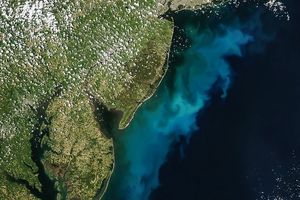





















Shades of iridescent blue dominated the Atlantic Ocean east of the Falkland Islands in mid-December 2011. The Moderate Resolution Imaging Spectroradiometer (MODIS) on NASA’s Terra satellite captured this natural-color image on December 14, 2011. Bright swirls form a giant arc hundreds of kilometers long.
The blue streak owed its existence to countless microscopic organisms. Phytoplankton—plant-like marine organisms that convert sunlight to energy—thrive in the cold, nutrient-rich waters of the Malvinas Current. Also known as the Falkland Current, it carries cold water along the southeast coast of South America. The phytoplankton-friendly conditions lead to frequent colorful blooms.
References & Resources
NASA image courtesy Jeff Schmaltz, LANCE/EOSDIS MODIS Rapid Response Team at NASA GSFC. Caption by Michon Scott.