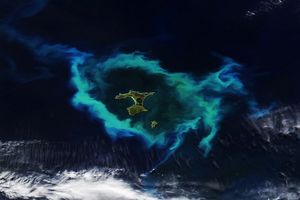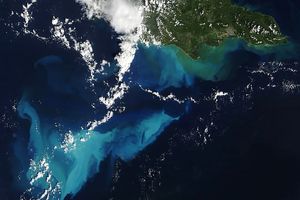


















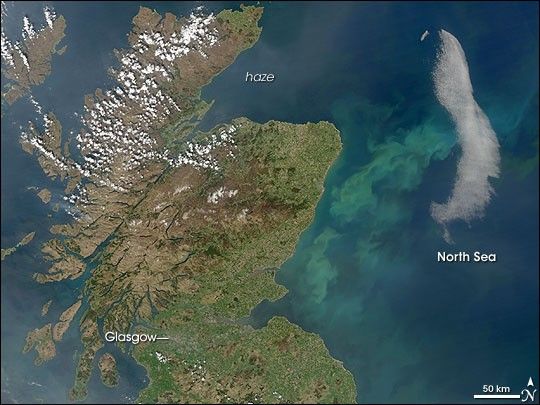
The northern and western highlands of Scotland were still winter-brown and even dusted with snow in places, but the waters of the North Sea were blooming with phytoplankton on May 8, 2008, when the Moderate Resolution Imaging Spectroradiometer (MODIS) on NASA’s Aqua satellite passed over the region and captured this image. The tiny, plant-like organisms swirled in the waters off the country’s east coast, coloring the shallow coastal waters shades of bright blue and green.
Phytoplankton are tiny organisms—many are just a single cell—that use chlorophyll and other pigments to capture light for photosynthesis. Because these pigments absorb sunlight, they change the color of the light reflected from the sea surface back to the satellite. Scientists have used observations of “ocean color” from satellites for more than 20 years to track worldwide patterns in phytoplankton blooms.
Phytoplankton are important to the Earth system for a host of reasons, including their status as the base of the ocean food web. In the North Sea, they are the base of the food web that supports Scotland’s commercial fisheries, including monkfish and herring. As photosynthesizers, they also play a crucial role in the carbon cycle, removing carbon dioxide from the atmosphere. Some oceanographers are concerned that rising ocean temperatures will slow phytoplankton growth rates, harming marine ecosystems and causing carbon dioxide to accumulate more rapidly in the atmosphere.
References & Resources
NASA image by Norman Kuring, Ocean Color Team, Goddard Space Flight Center. Caption by Rebecca Lindsey.