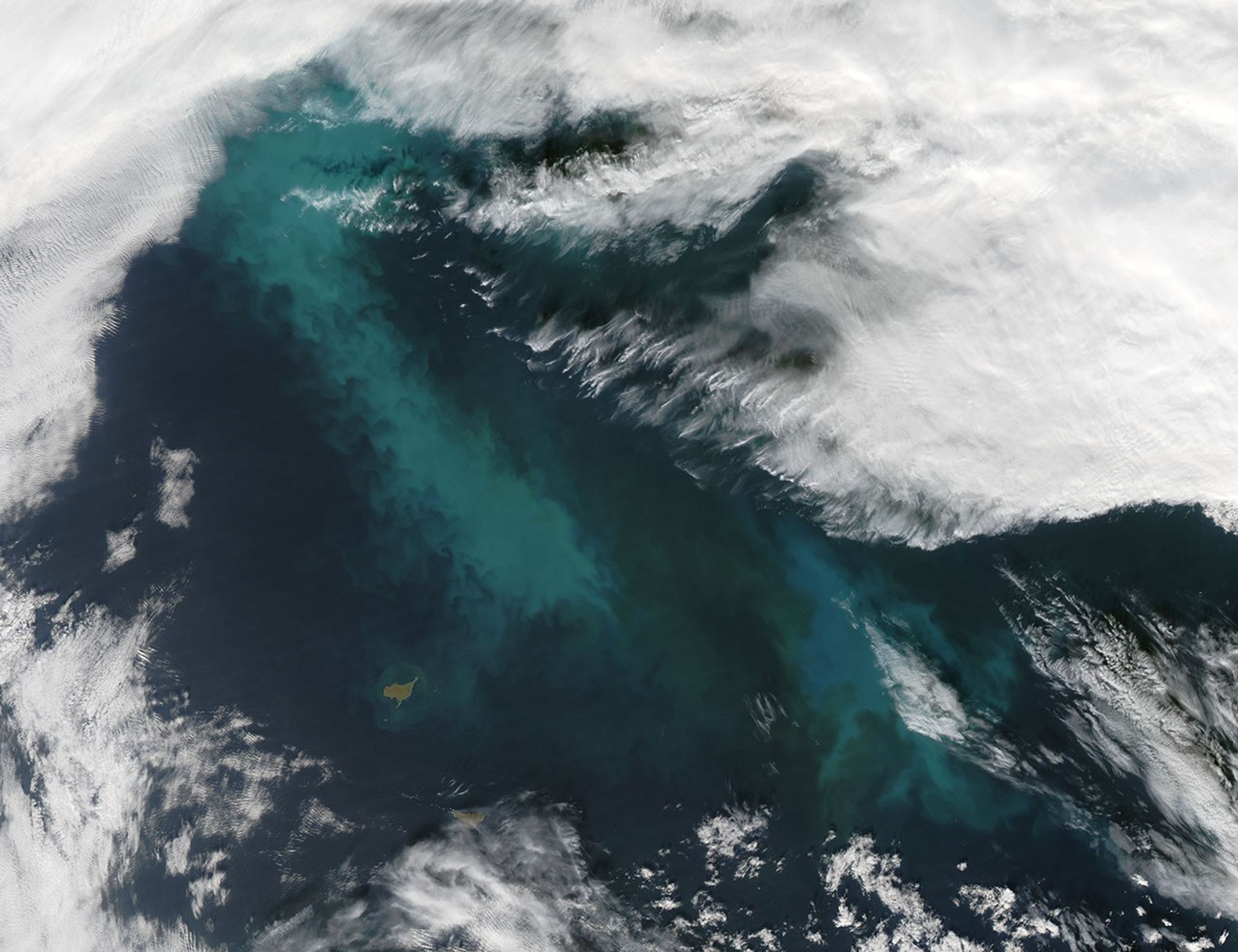






















Peacock-hued splashes of color brightened the Bering Sea off the Alaskan coast on October 8, 2009, as the Moderate Resolution Imaging Spectroradiometer (MODIS) on NASA’s Aqua satellite flew overhead. This true-color image shows streaks running roughly northwest-southeast, north and east of Alaska’s St. Paul Island. A close look at the bright areas reveals that they vary in color, and have uneven, swirling edges.
The color likely results in part from blooms of phytoplankton—tiny, plant-like marine organisms that thrive in cold water rich in nutrients. Like their terrestrial plant cousins, phytoplankton convert sunlight to energy, and the green chlorophyll that facilitates photosynthesis, combined with the blue of the sea water, often creates a brilliant blue-green.
The jewel tones in the Bering Sea may also result from suspended particulate matter that scatters light in the water column, especially in the patches of lightest color. Calcite plating of coccolithophores—single-celled, plant-like marine organisms—could comprise some of the light-scattering material.
References & Resources
NASA image by Jeff Schmaltz, MODIS Rapid Response Team, Goddard Space Flight Center. Caption by Michon Scott, based on interpretation by Norman Kuring, GSFC Ocean Color Team.