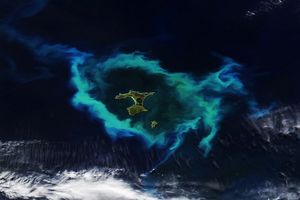
Given adequate sunlight and nutrients, phytoplankton populations can explode into blooms large enough to be visible from space. On July 6, 2016, the Moderate Resolution Imaging Spectroradiometer (MODIS) on NASA’s Aqua satellite acquired this natural-color image of a large phytoplankton bloom off the coast of New Jersey.
Nutrients to fuel a bloom can be carried to coastal waters from inland sources. The phenomenon was apparent in a recent bloom off the coast of Florida. Pollution-fed blooms can occur in Mid-Atlantic States as well, but blooms here can also be fueled by upwelling. When winds blow surface waters away from the coast, deeper, cooler, and often nutrient-rich waters will well up from the depths to fill the gap.
According to Oscar Schofield, a marine scientist at Rutgers University, the wind-driven upwelling is reflected in relatively cold water temperatures off the Jersey shore. “These upwellings occur every summer, and fuel large phytoplankton blooms,” he said. “Studies have suggested these summer upwelling events occur several times each summer and lead to large blooms that can discolor the water.”
Phytoplankton blooms are often harmless, and are an important food source for marine life. Other times, blooms can be harmful; they can deplete the water’s oxygen and suffocate marine life, and produce toxins that can be harmful to both aquatic creatures and humans.
References & Resources
- NASA Earth Observatory (2016, July 2) Bloom in Lake Okeechobee.
- NASA Earth Observatory (2015, August 9) Blooms off Both North American Coasts.
NASA image by Jeff Schmaltz, LANCE/EOSDIS Rapid Response . Caption by Kathryn Hansen.