



























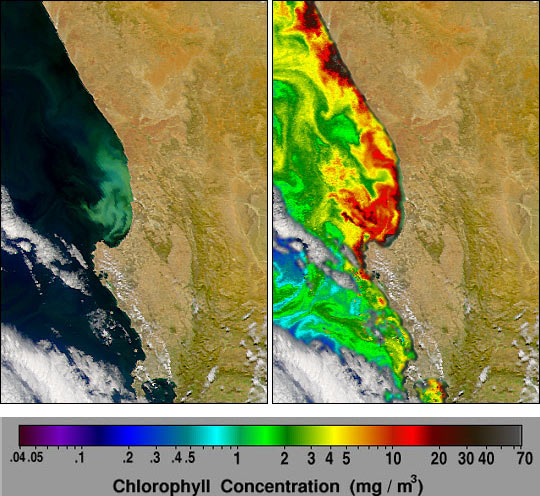
This Sea-viewing Wide Field-of-View Sensor (SeaWiFS) image from April 24, 2003, shows a natural-color panel (left) and a false-color panel (right) of a phytoplankton bloom off the west coast of South Africa. The false-color panel shows how many milligrams of chlorophyll were present in each cubic meter of seawater off the South African coast. Lowest values are in purple, and highest values are red.
From the natural-color panel, we can see where there are high concentrations of organisms from the bright blue and green swirls. However, the false-color panel shows that there is chlorophyll in the water that isn't so easily detected in the natural color panel. Notice, for example, how in False Bay at the bottom center of the image, the natural-color panel appears to show clear blue water, while the false-color panel reveals the high concentration of chlorophyll in yellows and reds.
References & Resources
Image provided by the Sea-viewing Wide Field-of-View Sensor (SeaWiFS) Project, NASA-GSFC, and ORBIMAGE