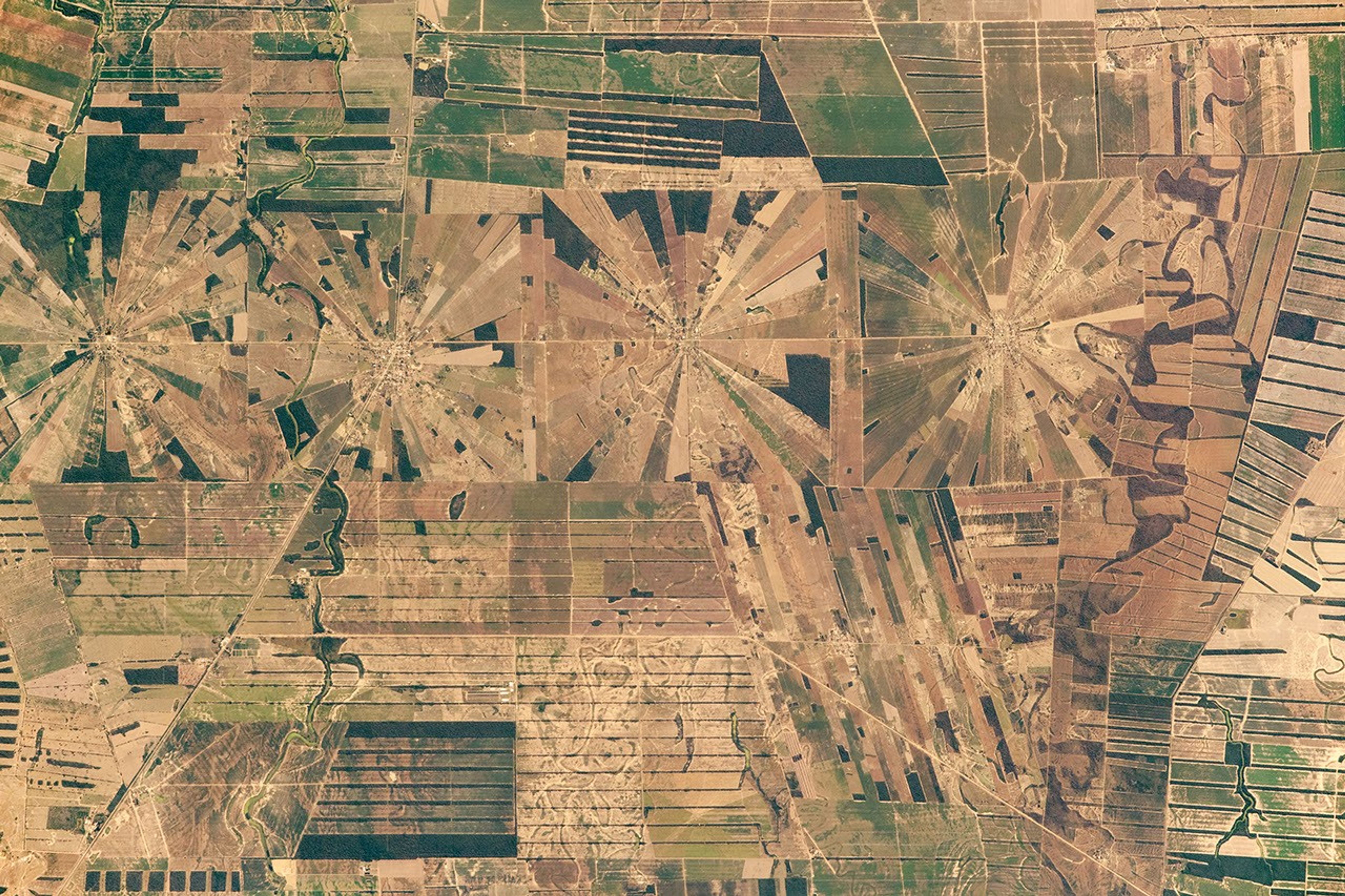


















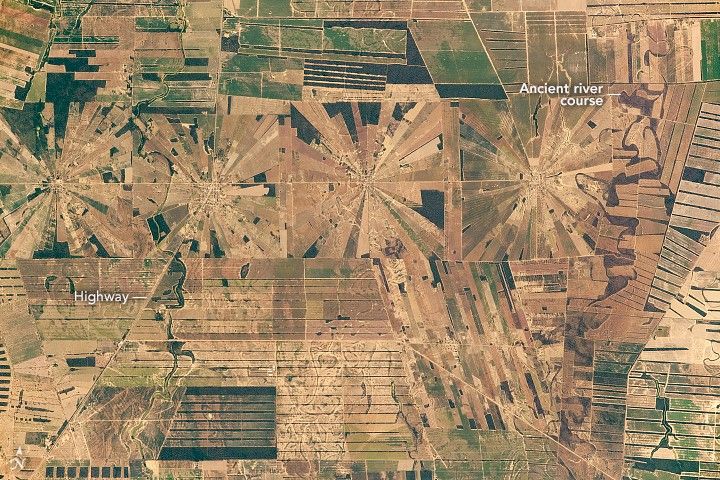
An astronaut aboard the International Space Station (ISS) focused a long lens on what may be a unique pattern on Earth for its size and repetitiveness. This series of adjacent agricultural fields is divided into square plots 4.4 kilometers wide, and each square has a “pinwheel” of triangular fields that radiate from a center point.
The square plots are part of a major resettlement project in Bolivia. The project was intended to help people from the Andes Mountains make a living through agriculture in the forested lowlands—the Tierras Bajas east of the Andes and northeast of the capital city, Santa Cruz de la Sierra.
Four such square plots occupy the middle of the image within the surrounding older patchwork pattern of linear fields. Small settlements occupy the center of each square. One of Bolivia’s main highways angles across a square through this settlement. The straight highway contrasts with the highly sinuous course of an ancient river nearby. Other ancient channels appear along the right side of the image.
Geologists now know that all of these channels are remnants of the Rio Grande, a large river that drains out of the Andes. Over thousands of years this river has deposited the sediment that makes the very large flat plain ideal for agriculture. The river also provides access to near-surface water and allows easy transport in all directions.
An earlier photograph taken by astronauts in 2001 shows a larger group of the same unique patterns, but much less filled out. A comparison of images from 1986 to 2001 shows the rapid deforestation that cut out the squares.
References & Resources
- Horton, B.K., and DeCelles, P.G. (1997) The modern foreland basins system adjacent to the Central Andes. Geology 25, 895â898.
Astronaut photograph ISS056-E-94529 was acquired on July 10, 2018, with a Nikon D5 digital camera using an 800 millimeter lens and is provided by the ISS Crew Earth Observations Facility and the Earth Science and Remote Sensing Unit, Johnson Space Center. The image was taken by a member of the Expedition 56 crew. The image has been cropped and enhanced to improve contrast, and lens artifacts have been removed. The International Space Station Program supports the laboratory as part of the ISS National Lab to help astronauts take pictures of Earth that will be of the greatest value to scientists and the public, and to make those images freely available on the Internet. Additional images taken by astronauts and cosmonauts can be viewed at the NASA/JSC Gateway to Astronaut Photography of Earth. Caption by M. Justin Wilkinson, Texas State University on the Jacobs Contract at NASA-JSC.