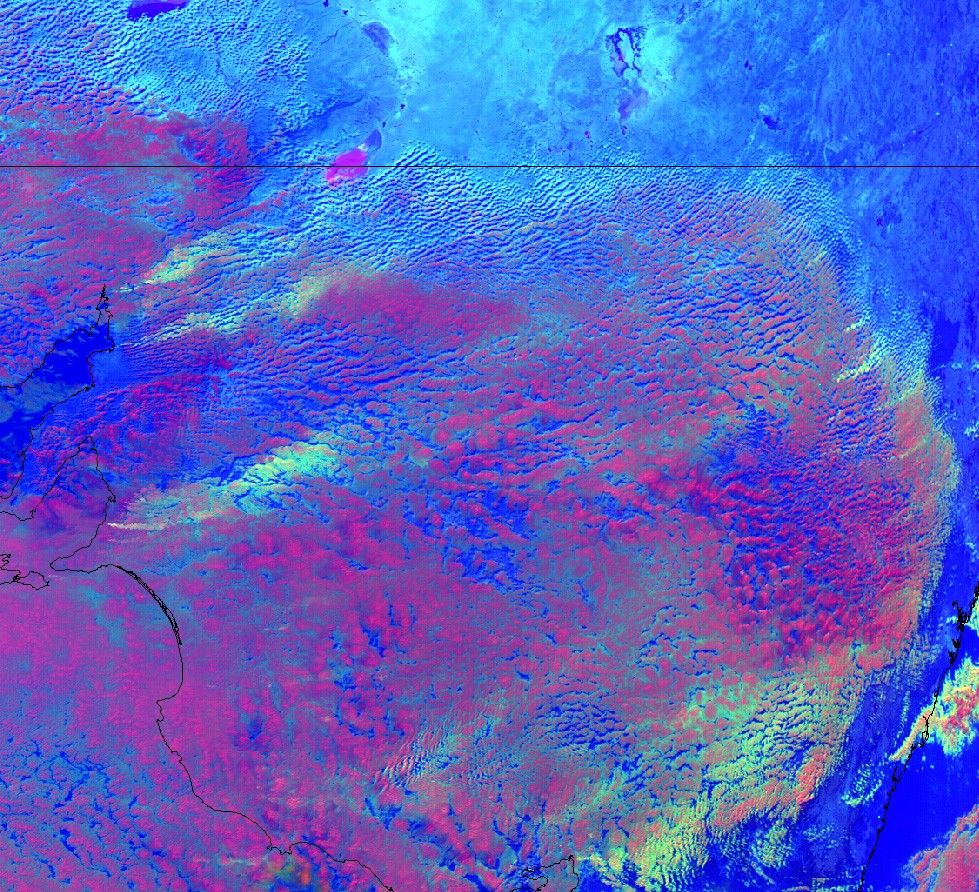
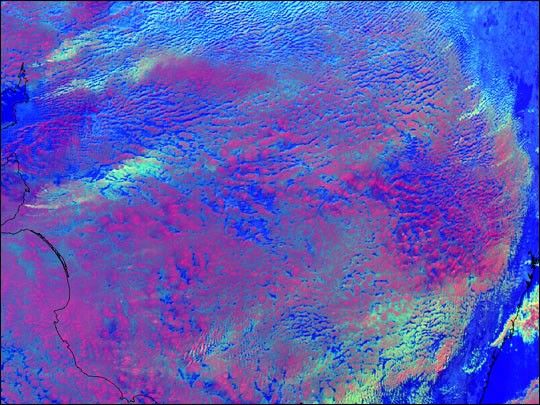
This false-color image over Australia,produced using NOAA Advanced Very High Resolution Radiometer (AVHRR) data, shows where pollution from humanindustry reduced clouds' particle sizes. Polluted clouds may rain less frequently then unpolluted cloudsbecause the pollutants prevent water droplets from growing large enough to precipitate.Blue areas are cloudless, while purplish-red areasare covered by thick clouds comprised of large droplets. Theyellowish-green and orange streaks are clouds comprised of smalldroplets. These latter clouds are more polluted than the purplish-redclouds and literally pointing to their sources of pollution.
Daniel Rosenfeld, a scientist collaborating with NASA, colored the visible, midwave-infrared, and thermal infraredAVHRR data as red, green, and blue, respectively, in this image todifferentiate clouds with different properties in a three-dimensionalway. Red was used to indicate the reflectiveness of the cloud invisible wavelengths. Green corresponds to droplet size. The more greenthere is in an area (as determined by AVHRR measurements of energyreflected at the 3.7 micrometer wavelength) the smaller the droplets. Blue was used to representthe clouds' temperature. The deeper the blue, the warmer thetemperature (determined by AVHRR measurements of brightness temperatureat 10.8 micrometer wavelength).
For more about interaction between pollution, clouds, and precipitation, visit “Changing our Weather One Smokestack at a Time.”
References & Resources
Image by Daniel Rosenfeld, Hebrew University of Israel