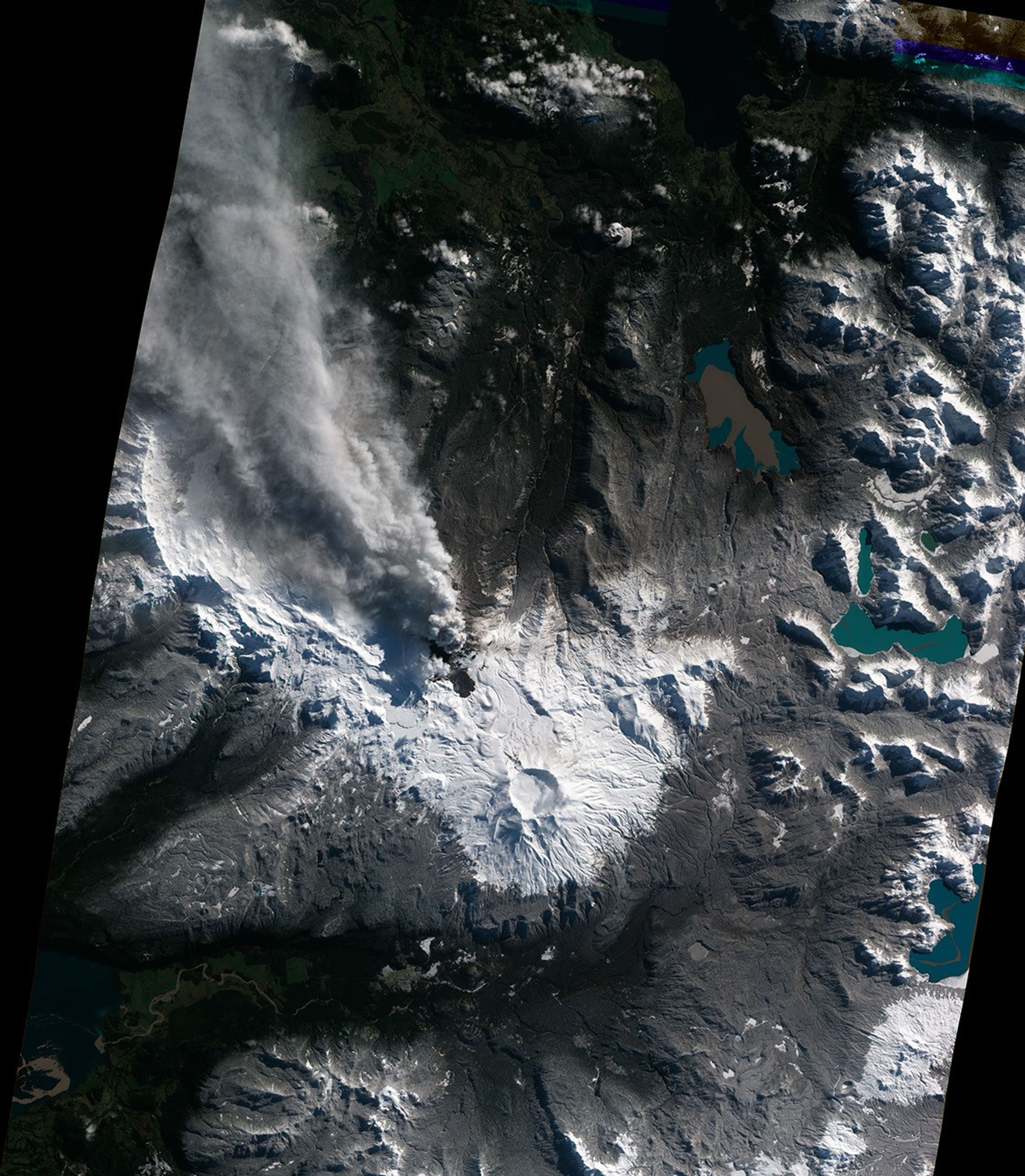





















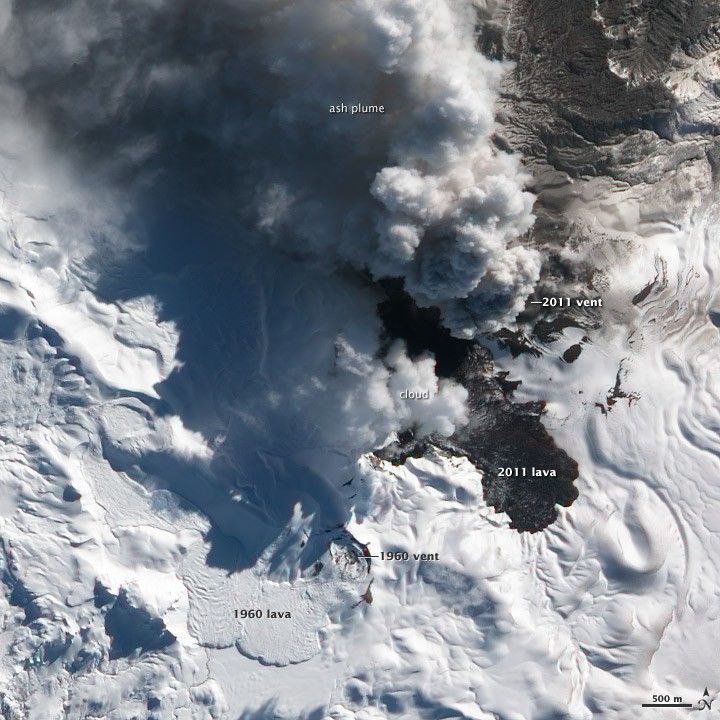
Puyehue Cordón Caulle Volcanic Complex emitted a pale plume of gas and ash on August 18, 2011. Activity started on June 4, 2011. The ongoing eruption has been characterized by explosive emissions of ash and larger tephra, as well as the outpouring of lava typical of an effusive eruption.
Evidence of both styles of eruption are visible in this natural-color satellite image, acquired by the Advanced Land Imager (ALI) aboard Earth Observing-1. A billowing ash plume indicates the explosive nature of the eruption. A fresh lava flow, darker than most of the surrounding, snow-covered landscape, illustrates the effusive aspect of the eruption. A light dusting of snow visible on the southern lobe of the flow indicates that the surface of the lava has cooled, although it was active as recently as July 31st.
Signs of an older eruption are visible to the southwest (lower left) of the fresh lava. A diagonal line of vents and craters marks the location of an eruption that started on May 24, 1960—only 38 hours after a magnitude 9.5 earthquake occured under the Pacific Ocean, about 200 kilometers (120 miles) away from Puyehue Cordón Caulle. This is one of the few eruptions conclusively linked to earthquake activity. Downslope from the vents are thick, snow-covered lava flows, similar in appearance to the lava emitted by the current eruption.
References & Resources
- Lara, L. E., Naranjo, J. A., and Moreno, H. (2004, June 22). Rhyodacitic fissure eruption in Southern Andes (Cordón Caulle; 40.5°S) after the 1960 (Mw:9.5) Chilean earthquake: a structural interpretation. Journal of Volcanology and Geothermal Research. 138 (1–2), 127–138.
- Servicio Nacional de Geología y Minería (SERNAGEOMIN). (2011, August 18). Reporte Especial de Actividad Volcánica No 109 Complejo Volcánico Puyehue—Cordón Caulle. Accessed August 19, 2011.
NASA Earth Observatory image created by Jesse Allen and Robert Simmon, using EO-1 ALI data from the NASA EO-1 team. Caption by Robert Simmon.