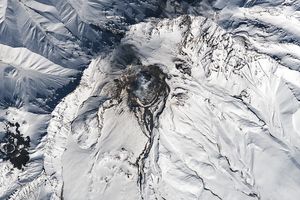






















Mount Cleveland is a tall, symmetrical stratovolcano composed of alternating layers of hardened lava, solidified volcanic ash, and rocks thrown out by earlier eruptions. The volcano occupies the western half of Chuginadak—an island shaped like a giant dumbbell and situated in the east-central Aleutian Islands. Cleveland is one of the most active volcanoes in the Aleutians, but in early March 2013, authorities lowered the volcano’s alert level to Advisory, meaning volcanic activity had decreased, but it would continue to be monitored closely for potential renewed activity.
On March 14, 2013, clouds cleared enough to allow the Advanced Land Imager (ALI) on NASA’s Earth Observing-1 (EO-1) satellite an unobstructed view of Mount Cleveland. Ash stained the snow around the summit, and the volcano sent a small plume skyward, but activity was minimal compared to the eruptive activity photographed by astronauts several years earlier.
References & Resources
- Global Volcanism Program (2013, March 12) Smithsonian / USGS Weekly Volcanic Activity Report. Accessed March 15, 2013.
- Global Volcanism Program Cleveland. Smithsonian Institution. Accessed March 15, 2013.
NASA Earth Observatory image created by Jesse Allen and Robert Simmon, using Advanced Land Imager data from the NASA EO-1 team. Caption by Michon Scott.