




















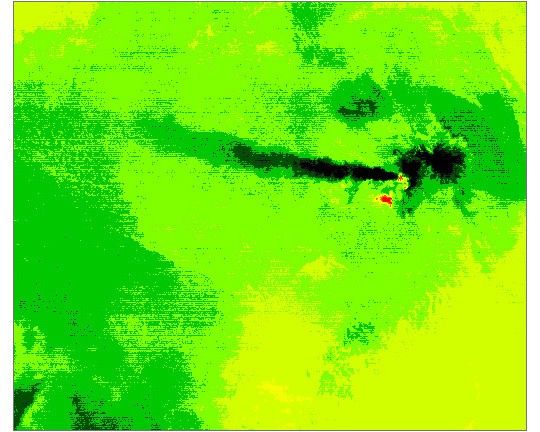
When the Shiveluch Volcano erupted on the night of June 4, 2001, the zoom lens aboard NASA's Terra spacecraft was watching. Using its thermal infrared detectors, the Advanced Spaceborne Thermal Emission and Reflection Radiometer (ASTER) captured this image of the event. Because the unaided eye cannot see heat, this image is color-coded so that red pixels show the hottest areas, light greens to dark green are progressively colder, and gray/black are the coldest areas.
Located on Russia's Kamchatka Peninsula, Shiveluch rises to an altitude of 2,447 meters (8,028 feet). The active lava dome complex is seen as the smaller red area on the summit of the volcano. To the southwest, the second and larger hot area is either a debris avalanche or hot ash ejected from the volcano. Trailing to the west (from right to left) is a 25-kilometer (15-mile) ash plume, seen as a cold "cloud" streaming from the summit.
At least 60 large eruptions have occurred here during the last 10,000 years. The largest historical eruptions were in 1854 and 1964.
Because Kamchatka is located along the major aircraft routes between North America/Europe and Asia, this area is constantly monitored for potential ash hazards to aircraft. The area is part of the "Ring of Fire," a string of volcanoes that encircles the Pacific Ocean.
References & Resources
NASA/GSFC/MITI/ERSDAC/JAROS, and U.S./Japan ASTER Science Team
None