












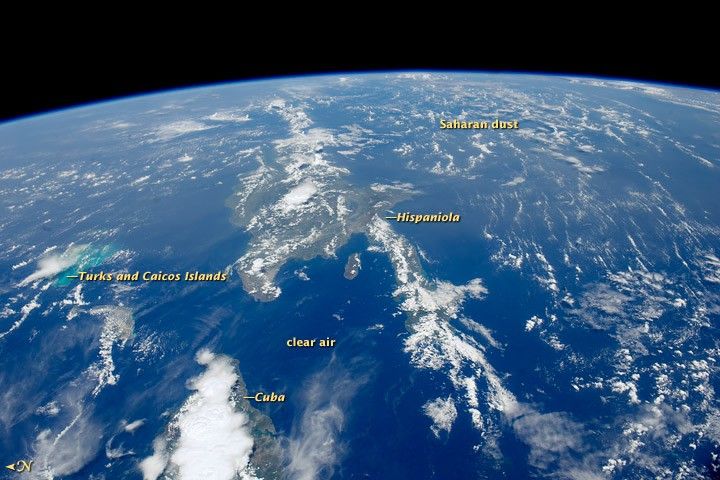

Weather satellites frequently document dust palls blowing westward from Africa’s Sahara Desert across the tropical Atlantic Ocean. Astronauts see these Saharan dust masses as widespread atmospheric haze. The dust can be transported right across the Atlantic Ocean, taking about a week to reach North America (in northern hemisphere summer) or South America (in northern hemisphere winter). This puts the Caribbean Sea on the receiving end of many of these events.
In the top image, the margin of hazy air reaches the island of Hispaniola (Haiti and Dominican Republic) and the Turks and Caicos Islands, though the eastern tip of Cuba (foreground) remains clear. This image—taken by astronauts on the International Space Station (ISS) in July 2012—attracted the interest of scientists at NASA’s Johnson Space Center because the margin between dust haze and clear atmosphere lies in almost the same location as it appeared in another astronaut image in July 1994. When astronauts aboard the Space Shuttle Columbia captured the lower image (rotated from the 2012 view), few scientists had considered the possibility of trans-Atlantic dust transport.
The Columbia image also shows the brilliant blues of the shallow banks surrounding the Caicos Island in the Bahamas. The mountainous spine of Haiti lies further away, partly obscured by dust. Closer to the foreground—about 26 degrees north latitude—the skies are clear.
The dust in the images is almost 8,000 kilometers from its likely source in northern Mali, although data from sensors such as the Total Ozone Mapping Spectrometer and Ozone Monitoring Instrument have suggested that some dust traveling across the Atlantic may originate even further east in Chad or Sudan. Once airborne, Saharan dust has been known to travel west all the way into the Pacific Ocean, crossing Mexico at the narrow Isthmus of Tehuantepec.
We now know that African dust reaches the western hemisphere every month of the year, though not necessarily in as visible a form as in these images. Researchers have linked Saharan dust to coral disease, allergies in humans, and harmful algal blooms (“red tides”). There is also evidence that some of this African dust serves as a source of airborne nutrients for Amazon rainforest vegetation.
References & Resources
Astronaut photograph ISS032-E-8976 was acquired on July 15, 2012, with a Nikon D3S digital camera using a 28 mm lens, and is provided by the ISS Crew Earth Observations experiment and Image Science & Analysis Laboratory, Johnson Space Center. The image was taken by the Expedition 32 crew. Astronaut photograph STS065-75-47 was acquired on July 7, 1994, with a Hasselblad Camera using a 100 mm lens and Kodak Lumiere film. Both images have been cropped and enhanced to improve contrast, and lens artifacts have been removed. The International Space Station Program supports the laboratory as part of the ISS National Lab to help astronauts take pictures of Earth that will be of the greatest value to scientists and the public, and to make those images freely available on the Internet. Additional images taken by astronauts and cosmonauts can be viewed at the NASA/JSC Gateway to Astronaut Photography of Earth. Caption by M. Justin Wilkinson, Jacobs/ESCG at NASA-JSC.