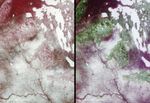













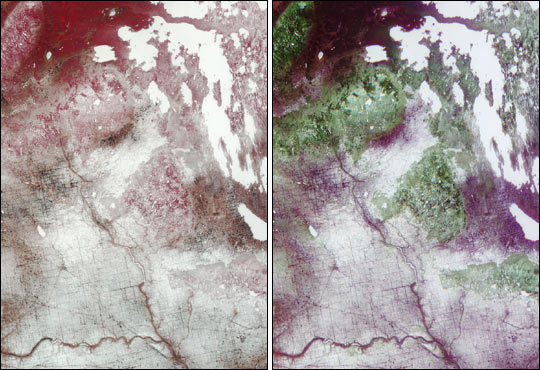
Surface brightness contrasts accentuated by a thin layer of snow enablea network of rivers, roads, and farmland boundaries to stand out clearlyin these Multi-angle Imaging Spectroradiometer (MISR) images ofsoutheastern Saskatchewan and southwesternManitoba. The lefthand image is a multi-spectral false-color view madefrom the near-infrared, red, and green bands of MISR's vertical-viewing(nadir) camera. The righthand image is a multi-angle false-color viewmade from the red band data of the 60-degree aftward camera, the nadircamera, and the 60-degree forward camera. In each image, the selectedchannels are displayed as red, green, and blue, respectively. The datawere acquired April 17, 2001, and cover an areameasuring about 285 kilometers x 400 kilometers. North is at the top.
The junction of the Assiniboine and Qu'Apelle Rivers in the bottom partof the images is just east of the Saskatchewan-Manitoba border. Duringthe growing season, the rich, fertile soils in this area supportnumerous fields of wheat, canola, barley, flaxseed, and rye. Beef cattleare raised in fenced pastures. To the north, the terrain becomes morerocky and forested. Many frozen lakes are visible as white patches inthe top right. The narrow linear, north-south trending patterns about athird of the way down from the upper right corner are snow-filleddepressions alternating with vegetated ridges, most probably carved byglacial flow.
In the lefthand image, vegetation appears in shades of red, owing to itshigh near-infrared reflectivity. In the righthand image, severalforested regions are clearly visible in green hues. Since this is amulti-angle composite, the green arises not from the color of the leavesbut from the architecture of the surface cover. Progressingsoutheastward along the Manitoba Escarpment, the forested areas includethe Pasquia Hills, the Porcupine Hills, Duck Mountain Provincial Park,and Riding Mountain National Park. The forests are brighter in the nadirthan at the oblique angles, probably because more of the snow-coveredsurface is visible in the gaps between the trees. In contrast, thevalley between the Pasquia and Porcupine Hills near the top of theimages appears bright red in the lefthand image (indicating highvegetation abundance) but shows a mauve color in the multi-angle view.This means that it is darker in the nadir than at the oblique angles.Examination of imagery acquired after the snow has melted shouldestablish whether this difference is related to the amount of snow onthe surface or is indicative of a different type of vegetationstructure.
Saskatchewan and Manitoba are believed to derive their names from theCree words for the winding and swift-flowing waters of the SaskatchewanRiver and for a narrows on Lake Manitoba where the roaring sound of windand water evoked the voice of the Great Spirit. They are two of Canada'sPrairie Provinces; Alberta is the third.
References & Resources
Image courtesy NASA/GSFC/LaRC/JPL, MISR Team.