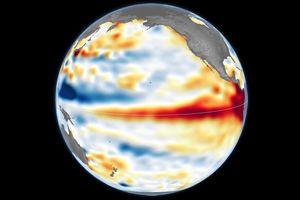



















A giant horseshoe pattern of higher than normal sea-surface heights developingover the last year is beginning to dominate the entire western Pacific andAsiatic oceans, new imagery from the U.S.-French TOPEX/Poseidon satellite shows.
“Warmer and cooler than normal sea-surface temperatures influence ouratmosphere every day, while sea-surface heights are a measure of how much heatis stored in the ocean below,” said Dr. William Patzert, an oceanographer at JPL. “When you put thesetwo pieces of the climate puzzle together, they will tell us both about what isinfluencing today's weather and how much heat is being stored inthe ocean to fuel future planetary climate events.”
The latest data, taken December 30, 1999 through January 8, 2000, show thatthis slow-developing condition covers most of the Pacific Ocean. The strengthof this climate trend is seen in this TOPEX/Poseidon satelliteimage. Sea-surface height is shown relative to normal (green) height and revealscooler water (blue and purple) measuring between 8 and 24 centimeters (3 and 9inches) lower than normal along the coast of Central and South America, andstretching out into the equatorial Pacific. The giant horseshoe of warmer water(red and white) dominating the western and mid-latitude Pacific has higher thannormal sea- surface heights of between 8 and 24 centimeters (3 and 9 inches). Forthe past year, warmer waters have been expanding slowly and are now beginning todominate the western and north Pacific.
For more information, visit the JPL El Niño/La Niña watch.
References & Resources
Image courtesy TOPEX/Poseidon project, NASA JPL
None