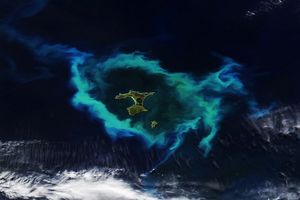





















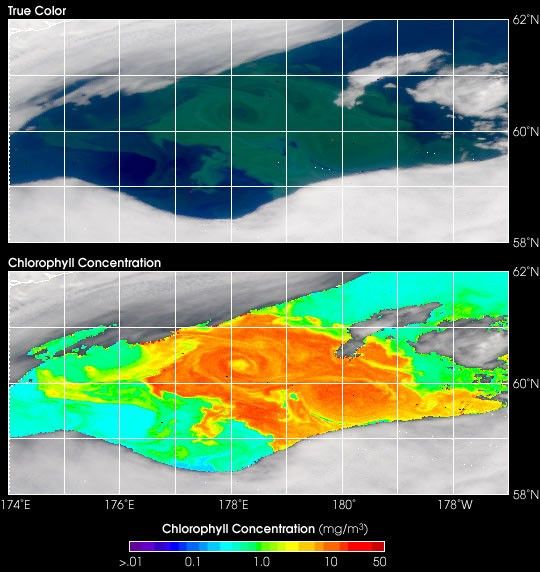
Every year in early summer, the ocean waters ofthe North Atlantic and North Pacific spring tolife with blooms of microscopic plants calledphytoplankton. Throughout the winter there is notenough sunlight to sustain large numbers of phytoplankton,even though the water is rich in nutrients. When thedays get longer and sunlight becomes more direct, thephytoplankton multiply rapidly. The chlorohpyll inthe masses of plants colors the water green.
This bloom in the Bering Sea, southof the eastern tip of Siberia, is visible in true colorimagery from the Sea-viewing Wide Field-of-view Sensor (SeaWiFS.) It wastaken on June 15th and 16th, 2000. (June 16th east of the Intenational Dateline,June 15th to the west) Although the true color image is spectacular, it does notprovide much information about the exact quantity of phytoplankton.SeaWiFS’ mission is to measure the concentration of chlorophyllin the water, which is proportional to the amount of phytoplankton.With this data scientists study the distribution of life in the oceans,the seasonal variability of the oceans, and how the ocean environmentis changing from year to year.
For more information, see the SeaWiFS project home page
and What are Phytoplankton?
References & Resources
Image provided by the SeaWiFS Project, NASA/Goddard Space Flight Center, and ORBIMAGE
None