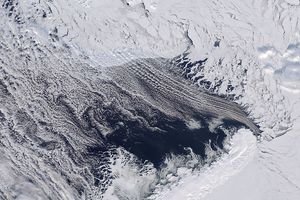















The progression of autumn brought notable changes to the Southern Hemisphere in late March 2025. Among them, sea ice around Earth’s southernmost continent started to regrow as air and water temperatures cooled. The MODIS (Moderate Resolution Imaging Spectroradiometer) on NASA’s Terra satellite captured this image of new ice forming atop the Amundsen Sea in West Antarctica.
The new sea ice, likely a type known as “grease ice,“ appears gray. Most of it has formed on the water near the fronts of Pine Island and Thwaites glaciers—two glaciers infamous for their outsized contributions to sea level rise. Sea ice, by contrast, is already floating and does not contribute to rising sea levels.
The new growth comes several weeks after sea ice around Antarctica reached its annual minimum, tying for the second-lowest extent in the satellite record. However, even as its expanse around the continent plummeted through the austral summer, sea ice in the Amundsen Sea Embayment was unusually persistent. Some of this surviving sea ice, also called “multi-year ice,” is visible as cracked white patches floating farther offshore.
While scientists are unsure why the area’s sea ice had staying power this year, several factors might have played a role. For example, the flow of warm water into the bay from under the glaciers’ ice tongues affects the amount of melting to varying degrees from year to year. Also, residual ice from the past winter can simply jam the bay, preventing winds and currents from moving ice away.
In contrast with the new and old sea ice, several areas of open water appear almost black, including the area immediately in front of Pine Island Glacier. These areas are likely ice-free due to a combination of relatively warm water that can well up below a glacier’s ice tongue and offshore winds capable of clearing out any ice that manages to grow there.
In the days after this image was acquired, sea ice grew even more widespread, and it will continue to thicken and expand through the dark, cold winter. Sea ice plays an important role around the margins of Antarctica, from providing habitat for animals to damping waves that can chip away at the floating fronts of adjacent glaciers and ice shelves.
References & Resources
- NASA Earth Observatory (2025, April 2) Antarctic Sea Ice Plunged in Summer 2025. Accessed April 15, 2025.
- NASA Earth Observatory (2025, March) World of Change: Antarctic Sea Ice. Accessed April 15, 2025.
- U.S. Geological Survey (2004) Coastal-Change and Glaciological Map of the Eights Coast Area, Antarctica: 1972-2001. Accessed April 15, 2025.
NASA Earth Observatory image by Michala Garrison, using MODIS data from NASA EOSDIS LANCE and GIBS/Worldview . Story by Kathryn Hansen with image interpretation by Christopher Shuman/UMBC (retired).