















On some hazy days, particularly in winter, China's skies are blanketed by white and gray clouds of air pollutants. New research shows that such smog not only dims the daylight and makes the air hard to breathe, but it reduces the amount of sunlight reaching China's solar panels.
In the new study, researchers at Princeton University examined how solar power resources in China are affected by atmospheric aerosols — small liquid and solid particles that can scatter sunlight back into space or increase cloud formation. The researchers used surface irradiance data from NASA's Clouds and the Earth's Radiant Energy System (CERES) and a computer model that calculates the impact of aerosols and clouds on surface radiation by examining the amount of solar energy falling on Earth’s surface.
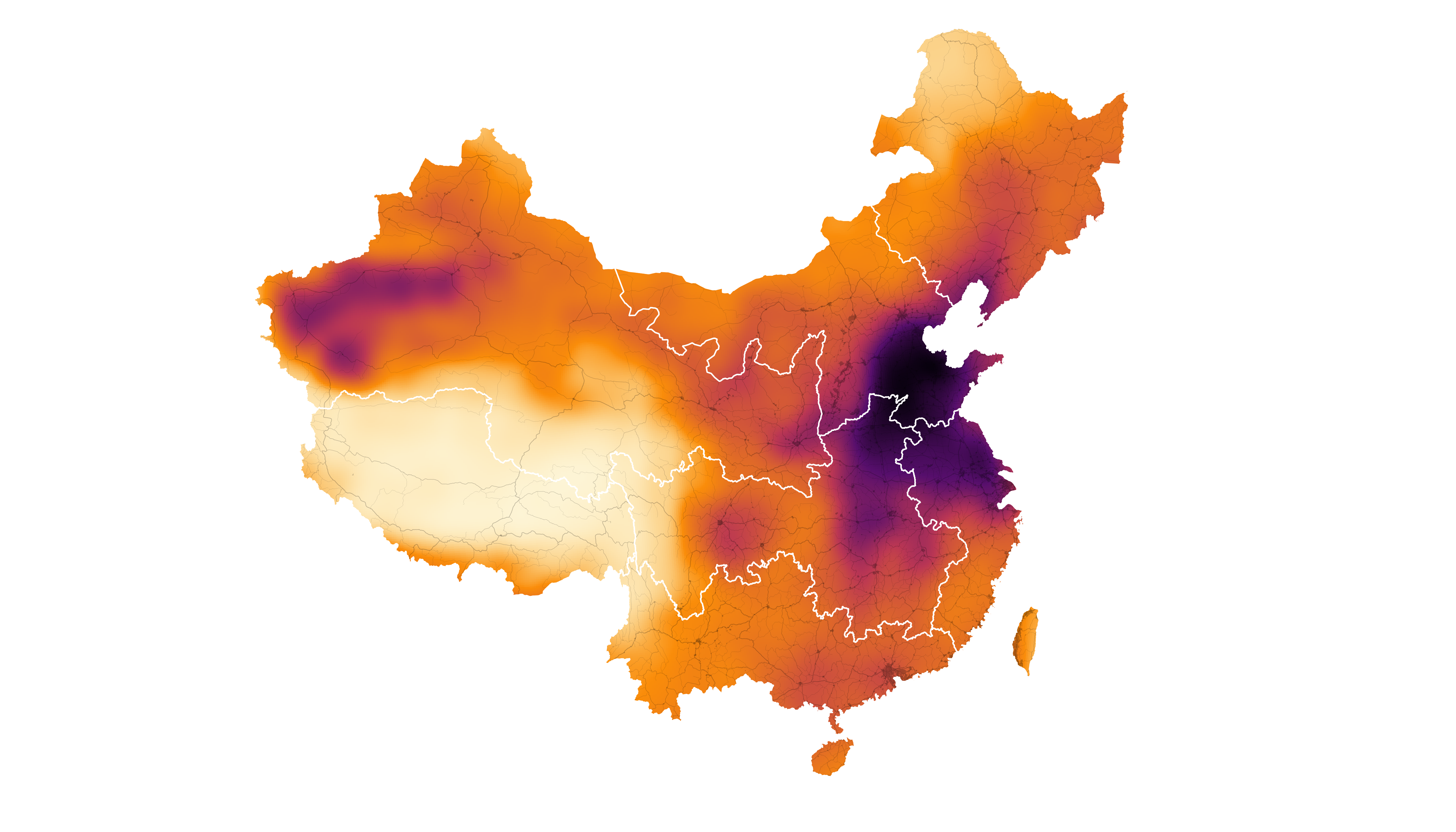
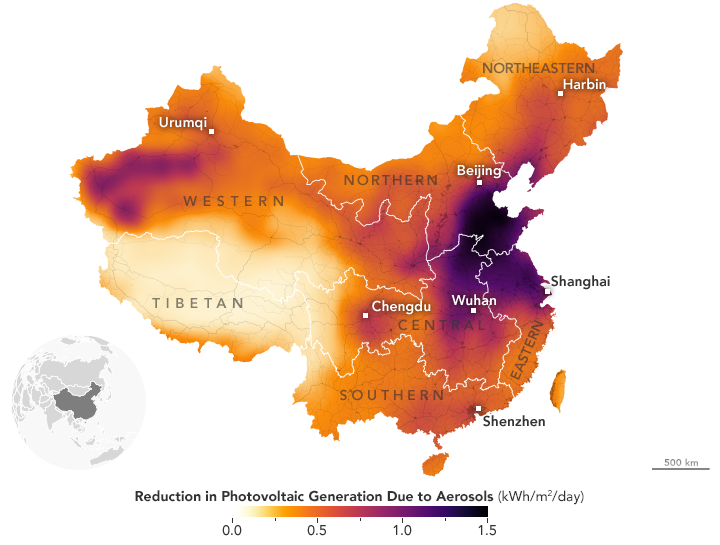
The visualization at the top of the page shows the average effect of aerosols on the amount of radiation reaching the land surface of China between 2003 and 2014. Northwestern and eastern China, the nation's most polluted regions, experienced the biggest dips. The researchers found that in the most polluted areas, available solar energy decreased as much as 35 percent, or 1.5 kilowatt-hours per square meter per day. That is enough energy to power a vacuum cleaner for one hour, wash twelve pounds of laundry, or run a laptop for five to 10 hours.
The results surprised the team. "When I asked around before conducting this study, people did not think aerosols would be a big deal in reducing solar energy potential," said Xiaoyuan (Charles) Li, the lead author of the paper and who recently graduated from Princeton with a PhD in Environmental Engineering. "There are a lot of cloudy days in China, and clouds are considered to be the major factor in reducing surface solar radiation."
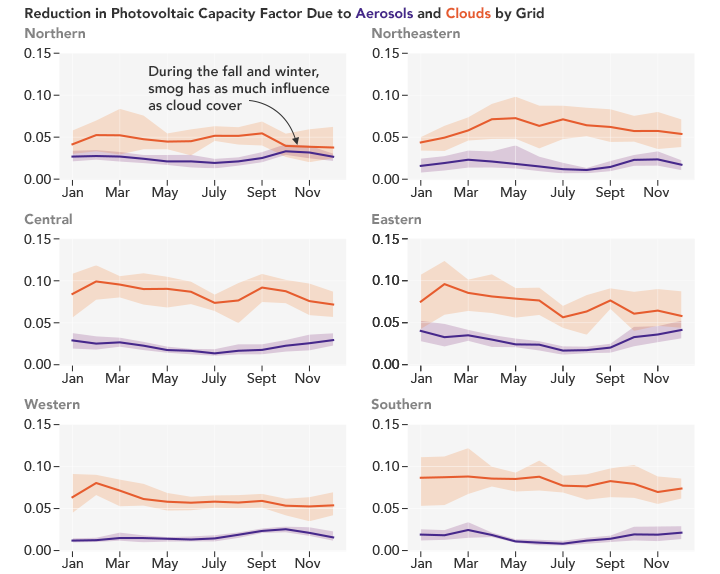
But the study showed that wintertime aerosols had nearly the same sunlight-blocking effect as clouds in northern China, as shown in the graphs above. Li noted that aerosols are more prevalent in China in the winter because coal is often burned for heat. In Beijing, the mountainous terrain also traps air masses, making it harder to blow aerosols away from the surface.
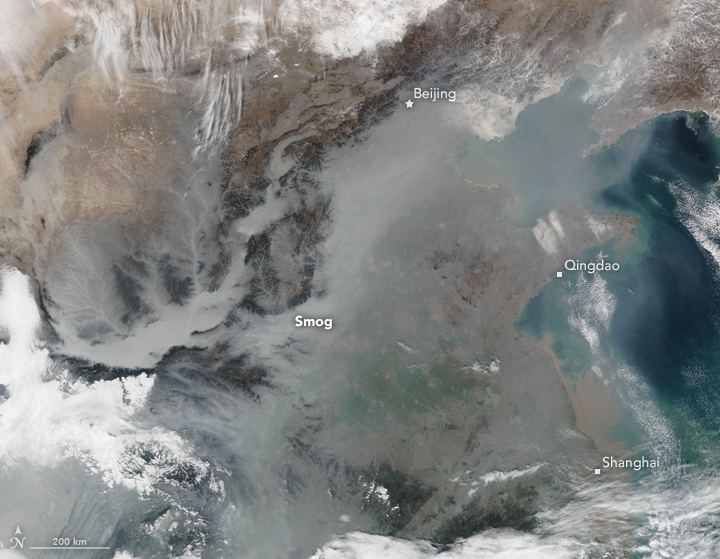
The natural-color image above shows thick haze over eastern China on January 25, 2017, as observed by the Visible Infrared Imaging Radiometer Suite (VIIRS) on the Suomi NPP satellite. Milky, gray smog blankets many of the valleys and lowlands. Atmospheric gases and pollutants are trapped near the surface in basins and valleys.
"As China's current efforts in fighting air pollution continue the benefit is not only for human health, but could also improve the efficiency of solar panels," said Li. By addressing its air pollution problem, China could improve its chances to meet its goal of producing 10 percent of the nation's electricity through solar energy by 2030.
References & Resources
- NASA Earth Observatory (2010, November 2). Aerosols: Tiny Particles, Big Impact.
- NASA Earth Observatory (2016, December 24). Smog Puts Dozens of Chinese Cities on Red Alert.
- NASA Earth Observatory (2017, January 26). Thick Haze in Eastern China.
- Li, X., et al. (2017, October 24). Reduction of solar photovoltaic resources due to air pollution in China. Proceedings of the National Academy of Sciences of the United States of America.
- Princeton University (2017, October 23). Air Pollution Cuts Solar Energy Potential in China. Accessed April 23, 2018.
NASA Earth Observatory images (first, second) by Joshua Stevens, using data from Li, Xiaoyuan, et al. (2017) . NASA image (third) by Jeff Schmaltz, LANCE/EOSDIS Rapid Response . Story by Kasha Patel.