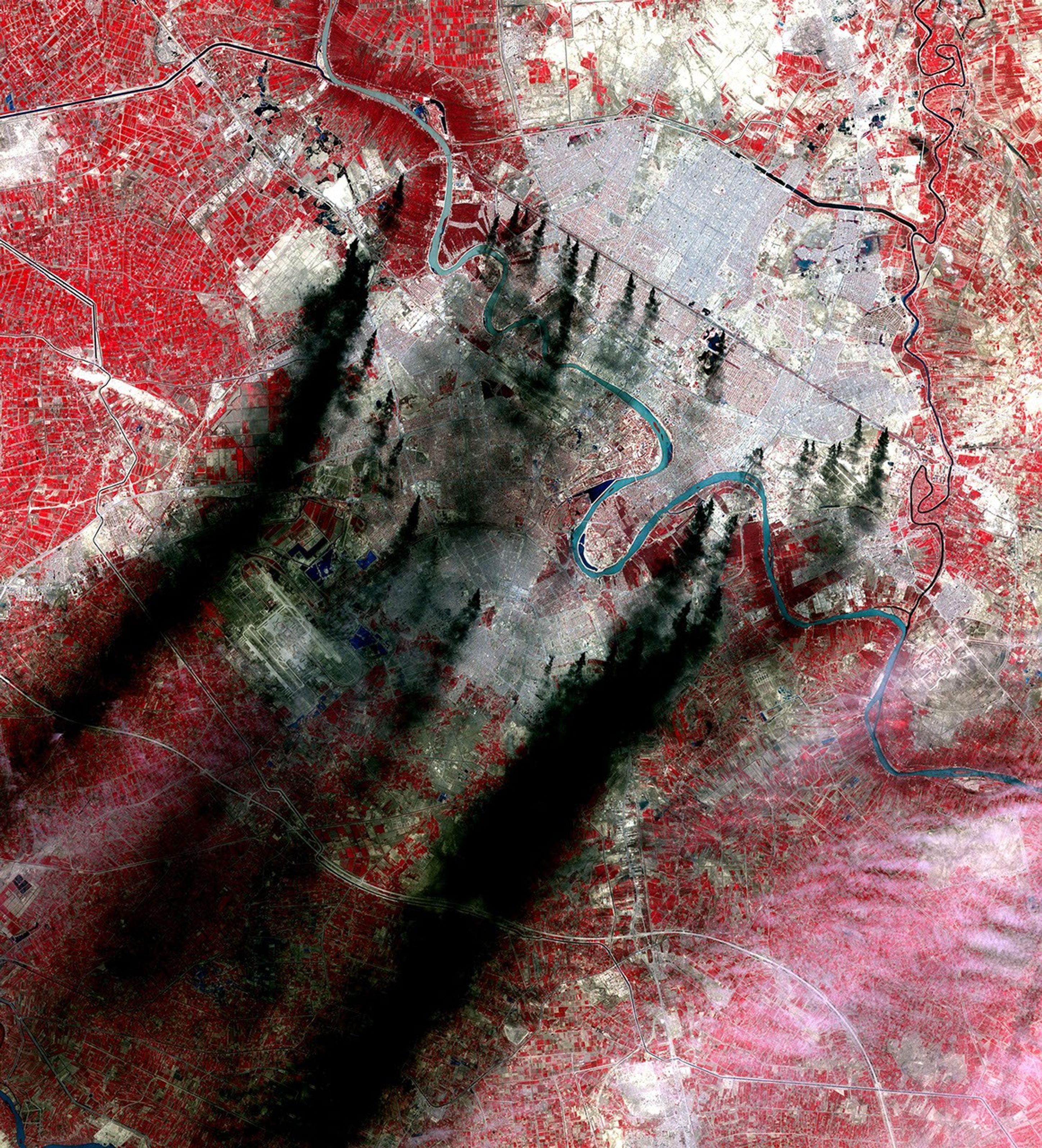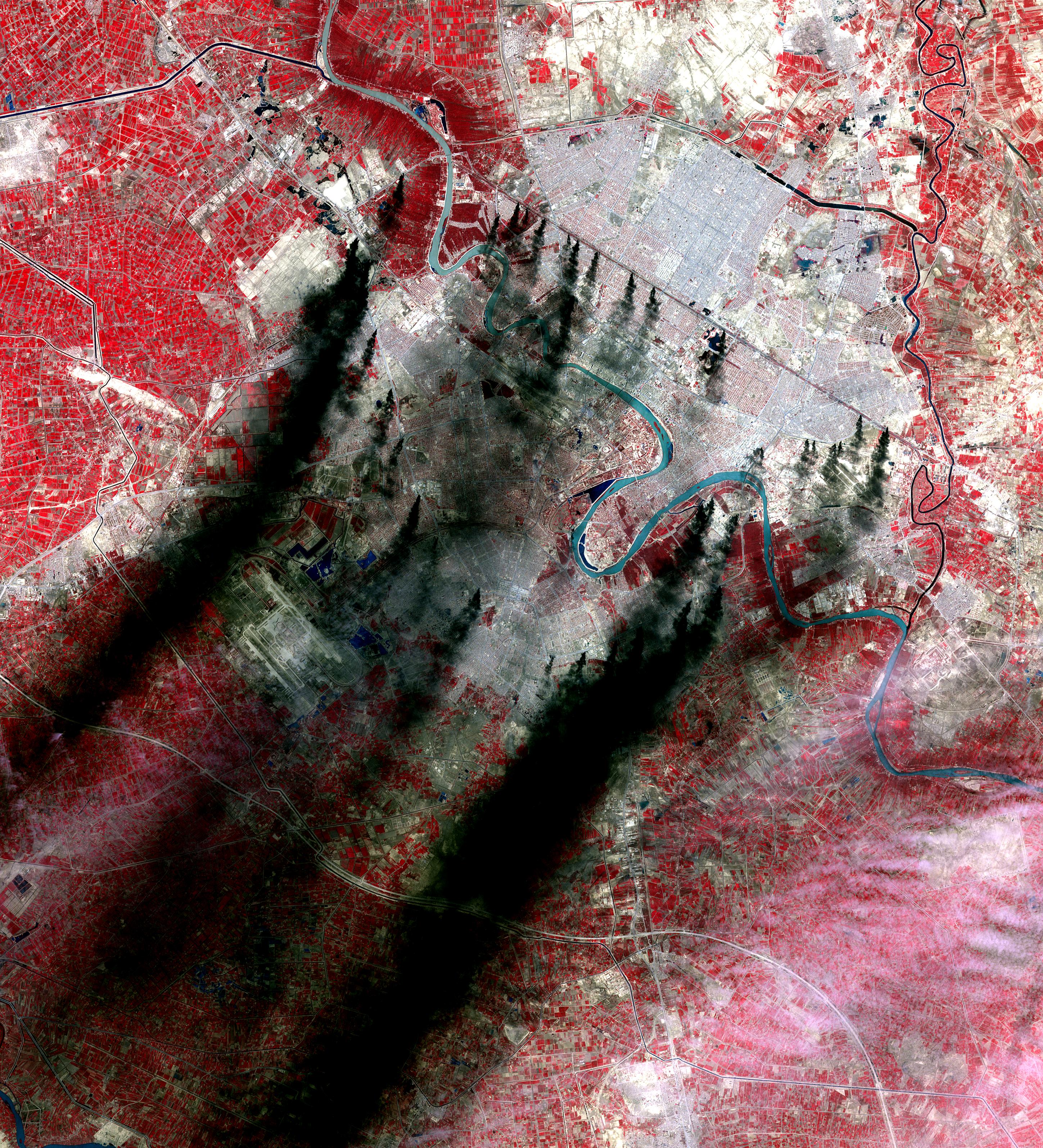



















This dramatic image of black smoke plumes over Iraq’s capitol city of Baghdad was acquired the morning of March 31, 2003, by the Advanced Spaceborne Thermal Emission and Reflection Radiometer (ASTER) instrument aboard NASA’s Terra satellite. The plumes, which originate along major roads and canals, are believed to be burning pools of oil from pipelines. The smoke blankets large sections of the city and creates an environmental health hazard for residents of the city and surrounding regions (with a population of about 5 million). Oil well fires in Kuwait in 1991 consumed more than 1 billion barrels of oil, and may be responsible for respiratory problems and increased cancer risk in the Persian Gulf.
In this scene, vegetation appears red because of the wavelengths used to make the image: near-infrared, red, and blue. Urban areas are grey. The full-size image covers an area of 44 by 46 kilometers (27 by 29 miles) at a spatial resolution of 15 meters (49.2 feet) per pixel. ASTER’s broad spectral coverage and high spectral resolution are ideally suited for monitoring man-made and natural changes in the environment.
References & Resources
Image courtesy NASA/GSFC/MITI/ERSDAC/JAROS, and U.S./Japan ASTER Science Team