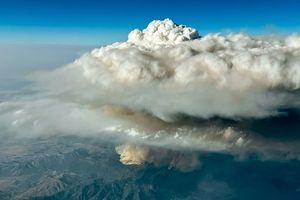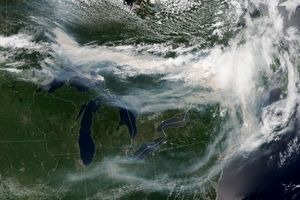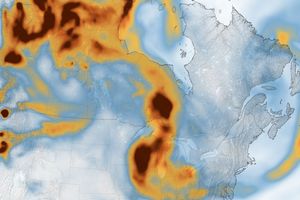












These images from the Multi-angle Imaging SpectroRadiometer (MISR) illustratethe abundance of smoke over the northeastern United States from fires burningin Qu‚bec on July 6, 2002. The images at left and center are natural colorviews acquired by MISR's vertical-viewing (nadir), and 70-degreeforward-viewing cameras, respectively. Although smoke is visible in the nadirimage, the oblique view angle greatly enhances the appearance of smoke.
The abundance of atmospheric particulates (aerosols) can be derived from thevariation of scene brightness and contrast as a function of observation angle,and is displayed by the map of aerosol optical depth on the right. Using thecurrent automated algorithms, reliable retrievals are not feasible for landareas covered by aerosols which totally obscure the underlyingsurface. In these areas, no retrievals were obtained (shown in darkgray) or a sporadic false result was returned (shown in red). Areaswhere clouds were successfully screened are also shown in dark gray.Elevated aerosol amounts (shown in blue-green and green) are visibleover New York City and the Atlantic Ocean.
The Multi-angle Imaging SpectroRadiometer views almost the entire Earth every 9days. These images were acquired during Terra orbit 13562 and cover an area ofabout 380 kilometers x 916 kilometers.
References & Resources
Image courtesy NASA/GSFC/LaRC/JPL, MISR Team