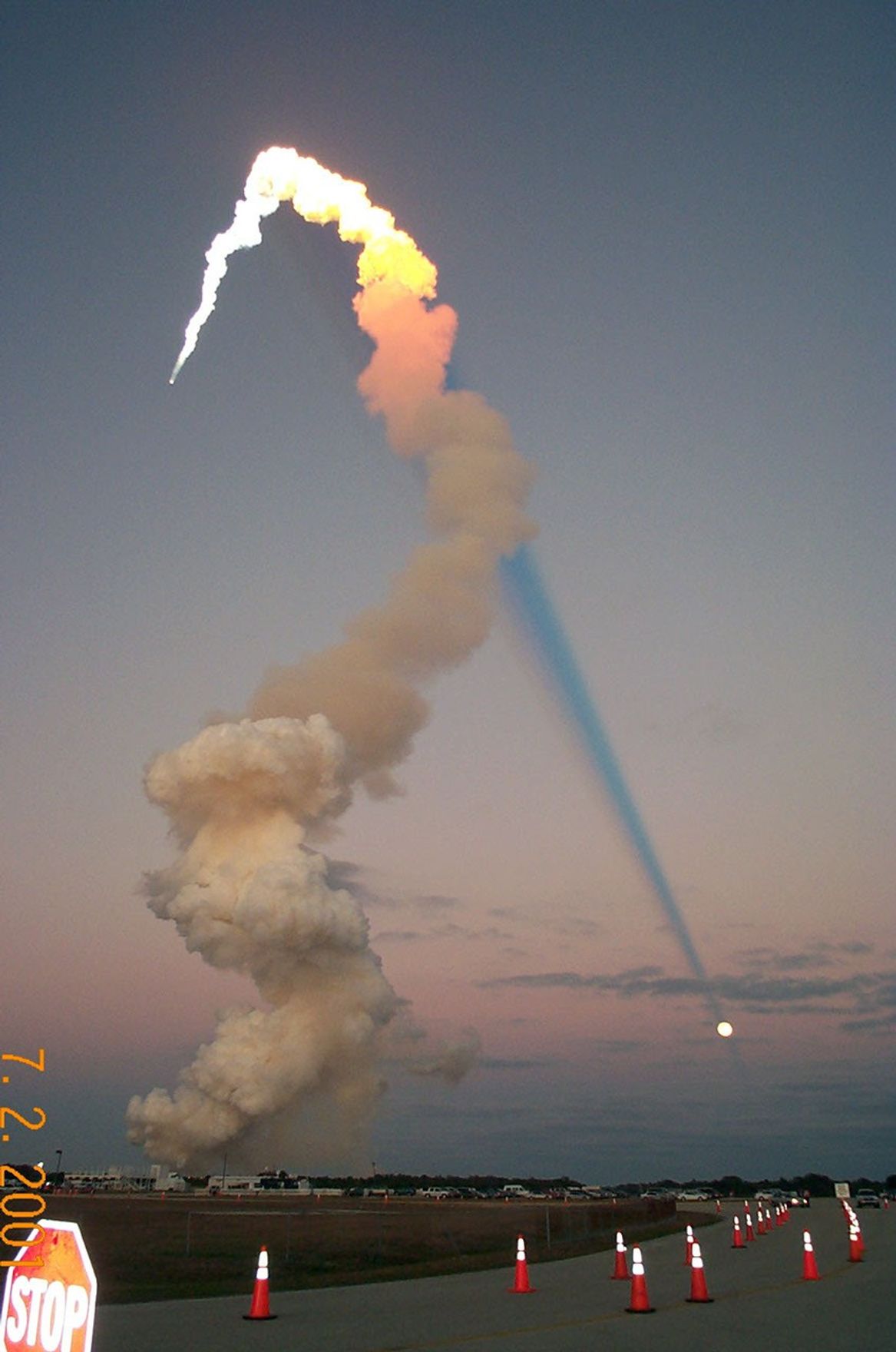

















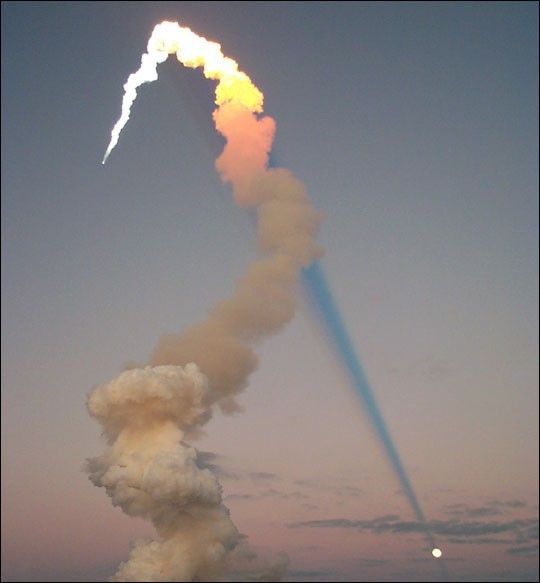
Can you guess what is shown in this photo? What is the plume extending upward from the ground? Why is the top of the plume brighter than its bottom? What is the bright object in the lower righthand corner of the picture, and what is the dark, cone-shaped feature that seems to be leaving the plume and converging on the bright object? Examine the picture carefully, look at the high-resolution version if you want to, and see if you can figure out the answers to these questions. Then, read the caption below to test yourself.
What is the Plume?
This is a photograph of the Space Shuttle (STS-98) launch on February 7, 2001, at 6:13 p.m. eastern time. The whitish plume is the pillar of smoke and steam left behind by the solid rocket boosters. Looking carefully, you can see a very bright dot at the top of the column of smoke, which is the flame still visible at the base of the solid rocket boosters. Even as the Space Shuttle is blasting into orbit, lower-level winds have begun to twist its pillar of smoke.
Why is the top part of the plume brighter?
This photo was taken near sunset, when the sun was relatively low on the western horizon. In the photo, you are looking eastward. The top portion of the plume is much brighter because it is being illuminated directly by sunlight, whereas the bottom portion of the plume lies within the Earth's shadow.
What is the bright object?
The bright orb in the lower righthand corner of the picture is the nearly full, sunlit face of the moon, which has already risen above the eastern horizon.
What is the dark feature?
The dark, cone-shaped feature extending downward and eastward from the pillar of smoke is its shadow.
Why does the shadow point at the moon?
Because the launch took place near the full moon, any shadow cast would have to appear to end at the moon since the Earth, moon, and sun were naturally in alignment. Remember, you are looking eastward at the moon, and the sun is above and behind you in this perspective.
References & Resources
Photo courtesy Patrick McCracken, NASA Headquarters. This photo was taken using a Kodak digital camera with a 2X telephoto lens.