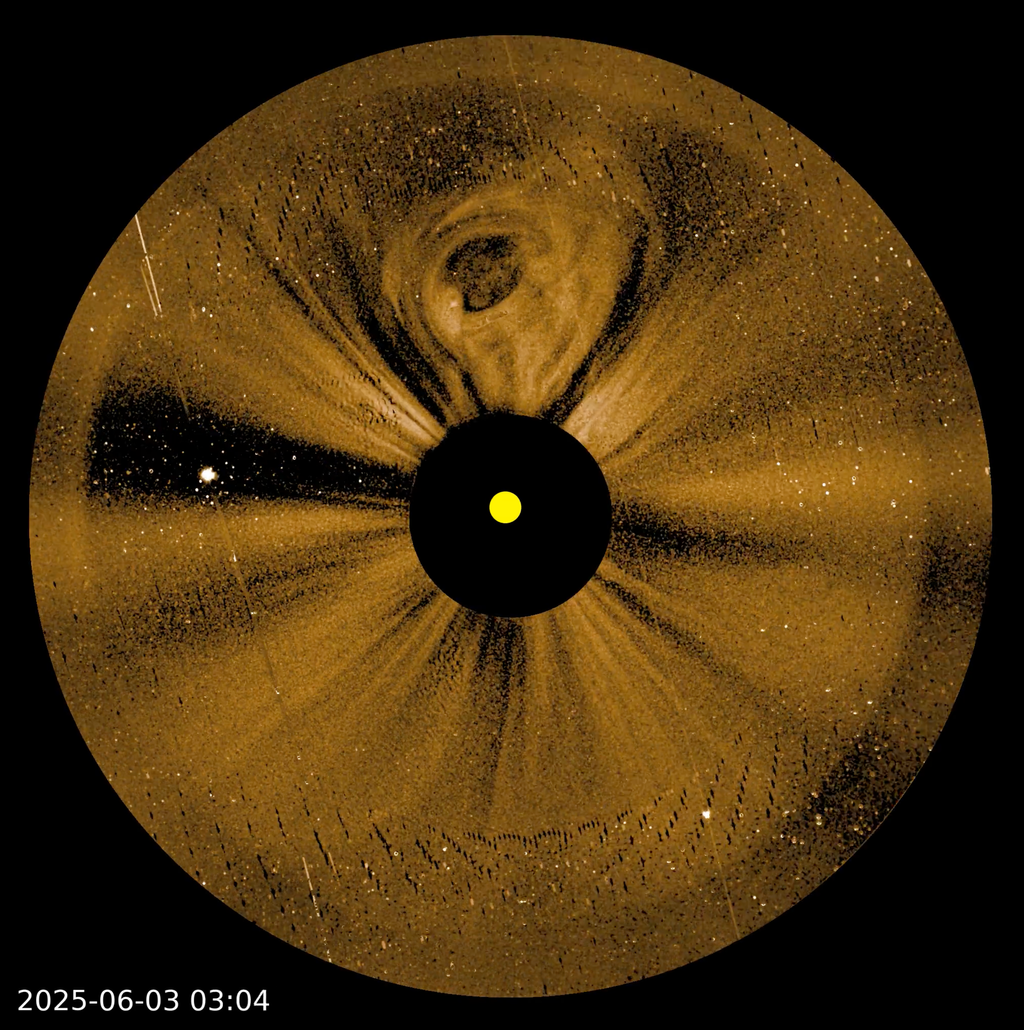













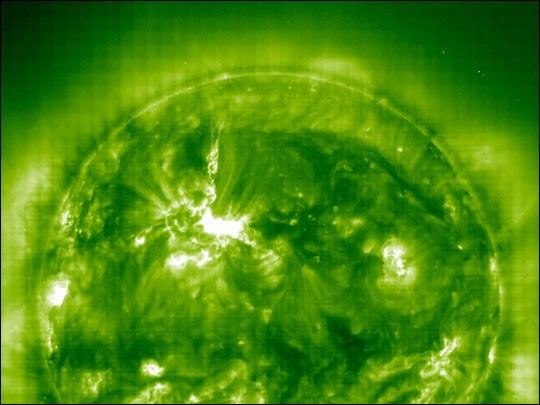
At the height of the solar cycle, the Sun is finally displaying some fireworks. This image from the Solar and Heliospheric Observatory (SOHO)shows a large solar flare from June 6, 2000 at 1424 Universal Time (10:24 AM Eastern Daylight Savings Time). Associated with the flare was a coronal mass ejection that sent a wave of fast moving charged particles straight towards Earth. (The image was acquired by the Extreme ultaviolet Imaging Telescope (EIT), one of 12 instruments aboard SOHO)
Solar activity affects the Earth in several ways. The particles generated by flares can disrupt satellite communications and interfere with power transmission on the Earth's surface. Earth's climate is tied to the total energy emitted by the sun, cooling when the sun radiates less energy and warming when solar output increases. Solar radiation also produces ozone in the stratosphere, so total ozone levels tend to increase during the solar maximum.
For more information about these solar flares and the SOHO mission, see NASA Science News or the SOHO home page.
For more about the links between the sun and climate change, see Sunspots and the Solar Max.
References & Resources
Image courtesy SOHO Extreme ultaviolet Imaging Telescope, ESA/NASA