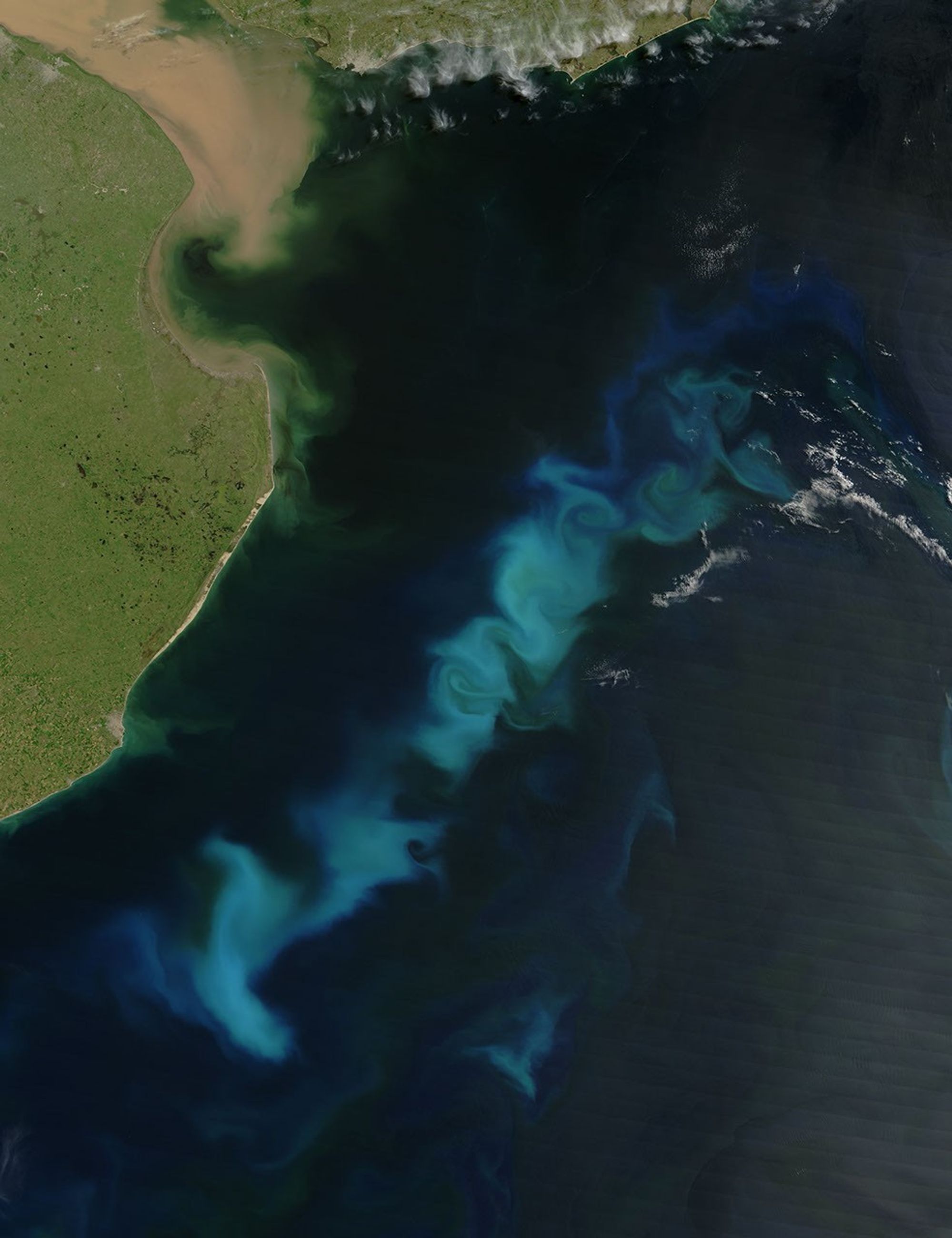















Summertime blooms of ocean plant life were coloring the waters of the South Atlantic Ocean with swirls of cobalt and turquoise on February 15, 2006. While sediment from rivers and streams that drain southern Argentina’s fertile, lowland plains (known as the pampas) stained the coastal waters greenish-brown, jewel-like blooms of tiny plants called phytoplankton stretched for hundreds of kilometers in the waters offshore. The region pictured in the image is just south of the Rio de la Plata estuary. (The large image shows most of the estuary.) The image was captured by the Moderate Resolution Imaging Spectroradiometer (MODIS) on NASA’s Aqua satellite.
Just like land plants, ocean plants are major players in the global carbon cycle. On a global basis, these tiny organisms withdraw about the same amount of carbon dioxide from the atmosphere during photosynthesis as land plants do. Blooms of phytoplankton are common along convergence zones—places where two or more ocean currents meet. In the South Atlantic, a current flowing southward along the coast of South America runs into a north-flowing current coming up from the Southern Ocean. The mixing of the two currents creates turbulence in the water. Turbulence pushes some water downward and pulls other water up toward the surface from deep in the ocean. These deep waters are often rich in nutrients that act like fertilizer for marine plant life. Routine satellite observations of the global ocean are the only way to get a planet-wide look at the timing, extent, and intensity of these blooms, which play such a key role in the carbon cycle.
References & Resources
NASA image courtesy Jeff Schmaltz, MODIS Land Rapid Response Team at NASA GSFC