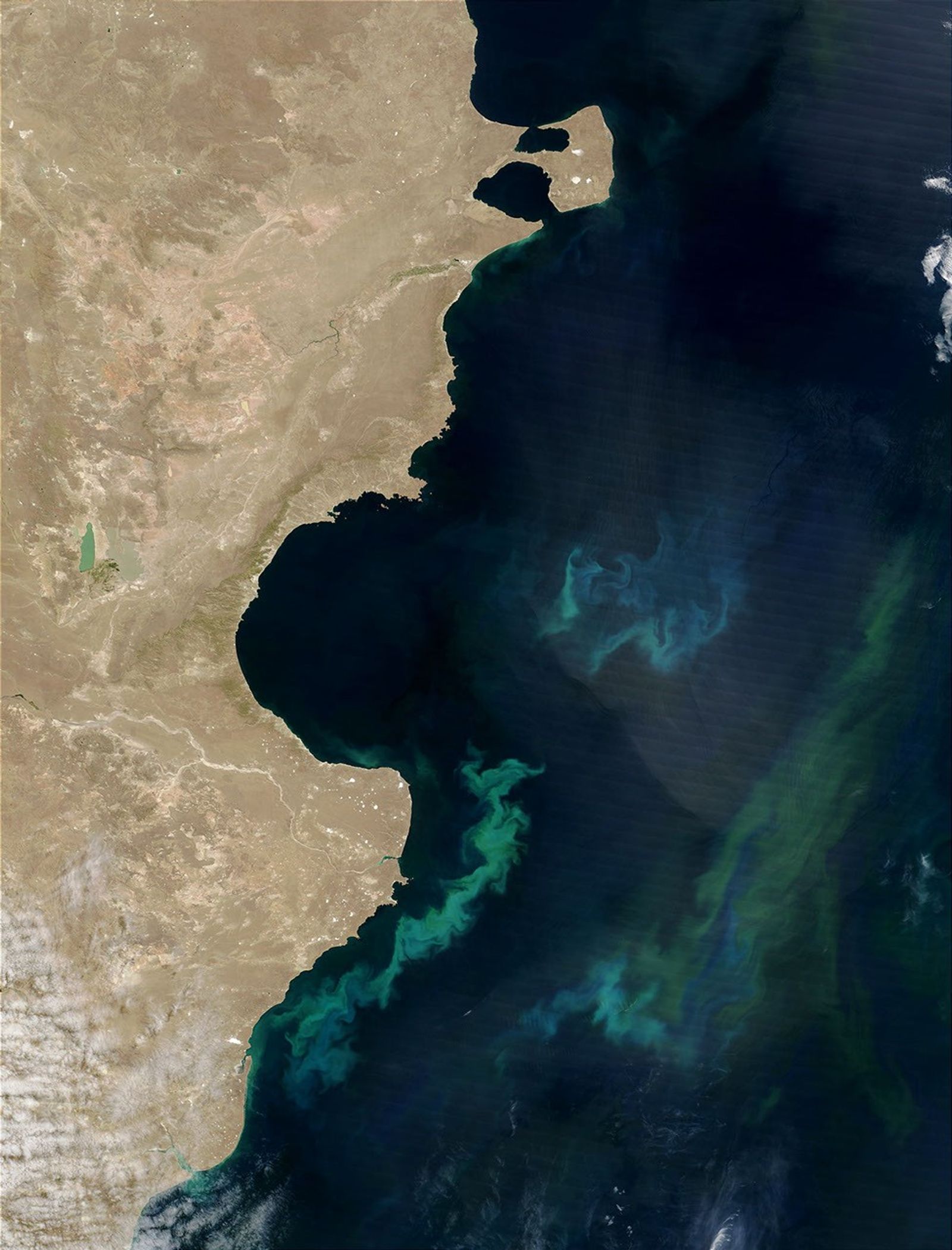



















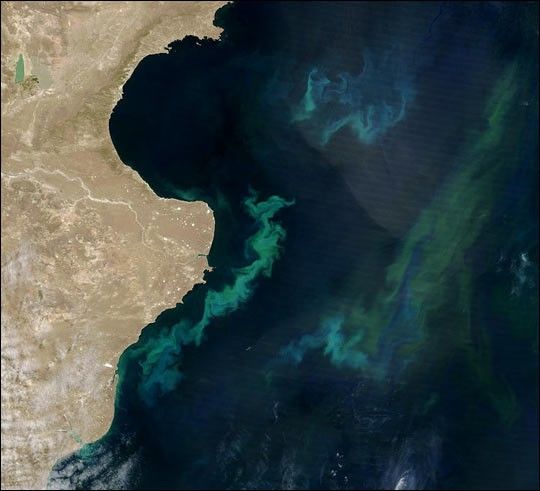
Off the east coast of Argentina, the South Atlantic Ocean is blooming with color. This true-color Moderate Resolution Imaging Spectroradiometer (MODIS) image from the Terra satellite on February 10, 2003, shows the waters off southern Argentina swirling with the blues and greens that indicate massive amounts of microscopic marine plants called phytoplankton. The blues and greens are caused by sunlight reflecting off the chlorophyll contained in the tiny, often single-celled plants.
Blooms in this area occur regularly due to the existence of what oceanographers call a convergence zone ?where two strong ocean currents meet. In this case, the convergence is that of the warmer, lower-nutrient Brazil Current, which flows southward toward the pole along the coast of South America and the northward-flowing Falkland Current. Although the exact meeting point varies, convergence is usually somewhere around 39 degrees south latitude. The turbulence caused by the convergence of the two currents causes upwelling in some areas, and cold-nutrient rich water is drawn up from the depths of the ocean, supporting phytoplankton blooms.
References & Resources
Image courtesy Jacques Descloitres, MODIS Rapid Response Team at NASA GSFC