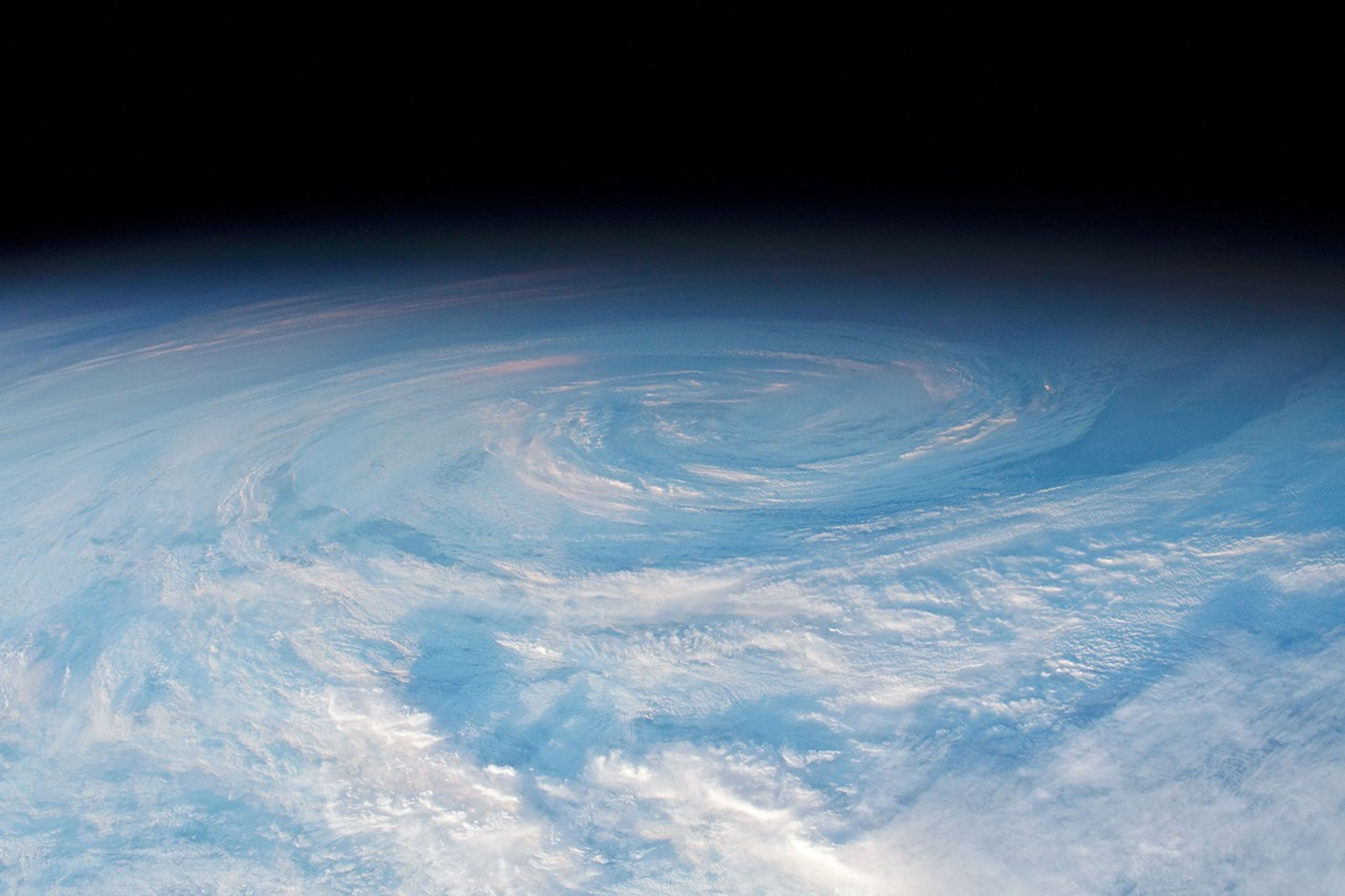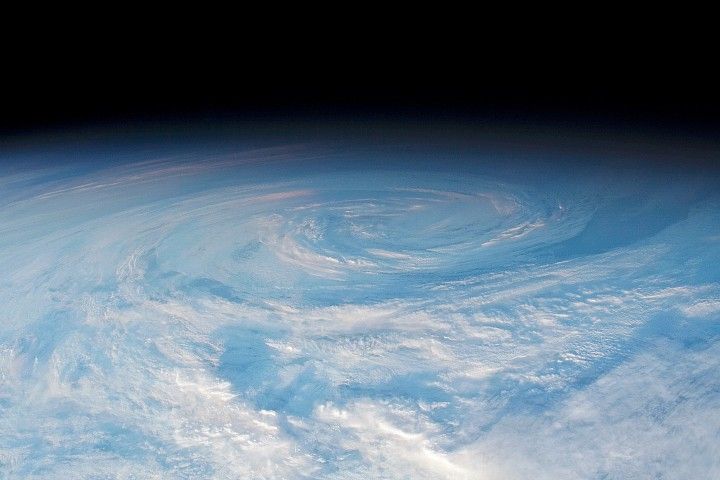
This circular cloud formation caught the eye of an astronaut while orbiting over the South Pacific Ocean. Traveling near the southernmost reaches of its orbit, the International Space Station (ISS) was more than 3,200 kilometers (2,000 miles) east of New Zealand and more than 4,400 kilometers (2,700 miles) west of South America.
The striking colors within the cloud formation are a result of the local sunrise. When the Sun is at a low angle (relative to the atmosphere and ISS), sunlight passes through a thicker slice of the atmosphere. This can enhance the red end of the visible color spectrum, leading to the pink hues visible at the center of the image.
When photos are taken close to the day-night line (also known as the terminator), the sunlight can cast shadows that accentuate contrasting cloud heights and make the sense of circular motion more distinct to the eye. This photo was taken while the astronaut was looking back toward the night hemisphere, so the clouds become less defined as they fade into the terminator.
The astronaut who took this photograph sent a message from the ISS to ask if this specific cloud formation had been a named tropical cyclone. However, because the weather system was short-lived, the storm dissipated before making landfall, and thus was not named.
References & Resources
Astronaut photograph ISS059-E-11742 was acquired on April 4, 2019, with a Nikon D5 digital camera using a 50 millimeter lens and is provided by the ISS Crew Earth Observations Facility and the Earth Science and Remote Sensing Unit, Johnson Space Center. The image was taken by a member of the Expedition 59 crew. The image has been cropped and enhanced to improve contrast, and lens artifacts have been removed. The International Space Station Program supports the laboratory as part of the ISS National Lab to help astronauts take pictures of Earth that will be of the greatest value to scientists and the public, and to make those images freely available on the Internet. Additional images taken by astronauts and cosmonauts can be viewed at the NASA/JSC Gateway to Astronaut Photography of Earth. Caption by Sara Schmidt, GeoControl Systems, JETS Contract at NASA-JSC.