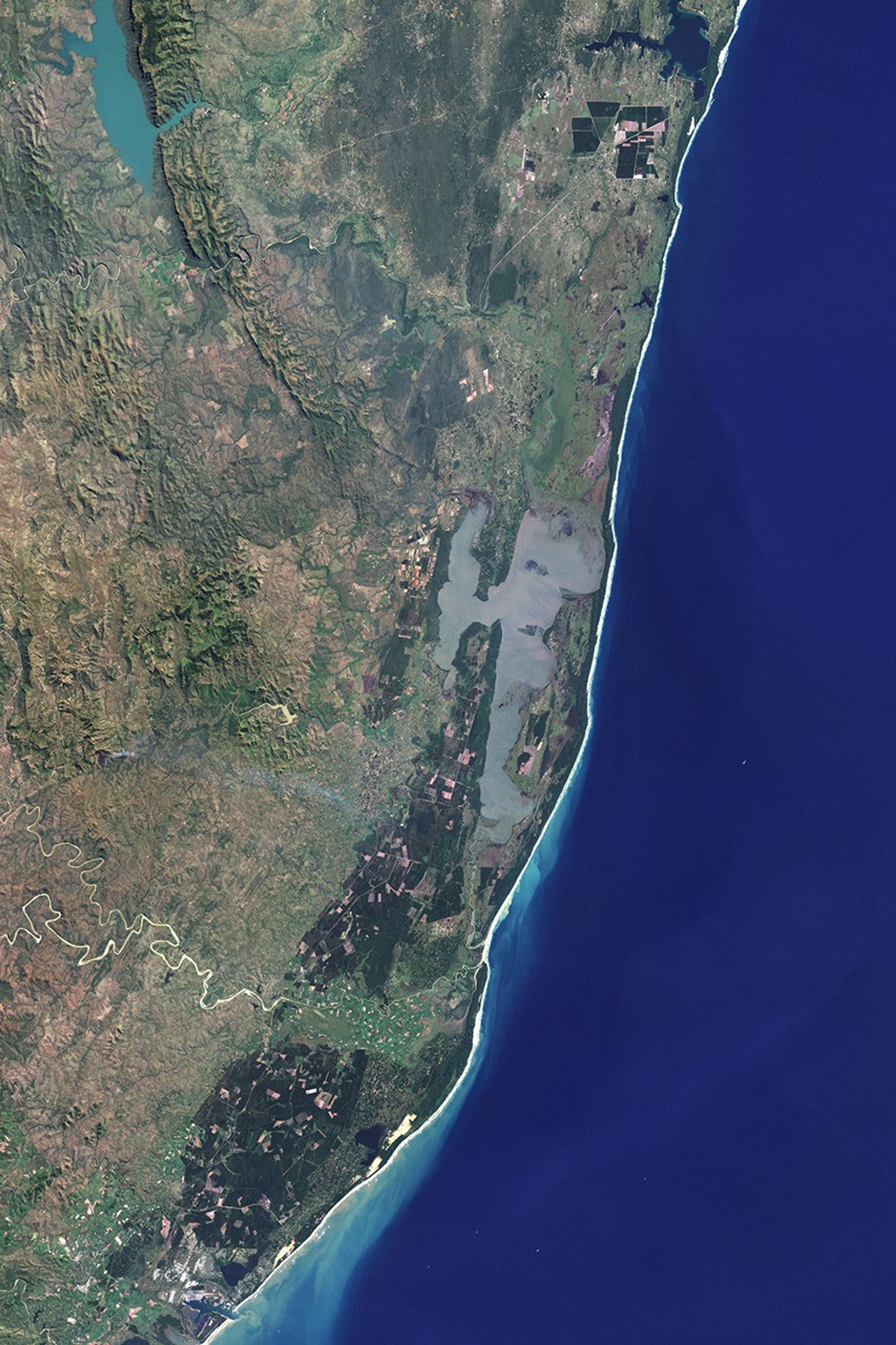
















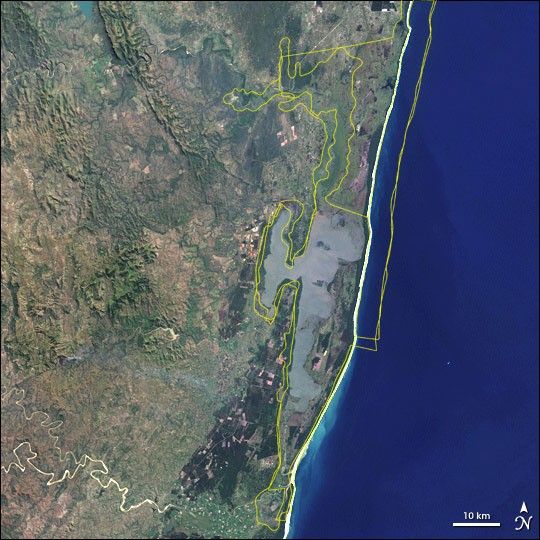
The Greater St. Lucia Wetland Park is a United Nations World Heritage Site located on the Indian Ocean coast of South Africa near the borders with Mozambique and Swaziland. The parkencompasses several different conservation areas (marked with yellow lines) centered on Lake St. Lucia, itstidal estuary, neighboring game reserves, and the St. Lucia Marine Reserve, whichextends offshore into the Mozambique Strait (image right). The oldest of the reserveswithin this park, St. Lucia Game Reserve, was established in 1895.
Like many tidal estuaries, Greater St. Lucia has diverse wildlife reflectingthe concentration of diverse ecosystems created by variations in the degree ofsalinity from season to season, year to year, and location to location within thepark. The estuary is the largest in Africa and boasts, among other attractions,the world’s largest forested sand dunes, which reach up to 600 feet. Swamps alongthe border of the lake, and “sponge” areas are fed by water seeping through thedunes; these provide critical refuges to freshwater life when the lake salinityis particularly high.
Though less well known than larger southern African parks like Kruger National Parkand the Okavango Delta, St. Lucia supports more species, and for some, St. Lucia iscritical habitat. These include the white-backed and pink-backed pelican, greater and lesser flamingos, fish eagles, and some 530 other bird species. It isalso home to the largest population of hippopotamus in South African parks. Elephants were reintroduced in2001. Two sea turtle species use the beaches for laying eggs. The coastal reserveincludes not only beaches butoffshore coral reefs, and humpback whales migrate along this section of thecoast. It is the one park in Africa where you can find hippopotamus, crocodiles, andsharks all in the same area.
But of all the interesting species in the area, perhaps none is so exotic, exciting,and peculiar as the coelacanth. It is a fish species from millions of years ago that wasknown to scientists from fossil records and presumed to have been extinctuntil a live specimen was found in a trawler net in 1938 just off the African coast.Scientists have since found a number of these bizarre four-legged fish in very deep,rocky, marine environments, but it is still a very rare fish and protected underinternational law. On November 27, 2000, three living specimens of coelacanth werefound and photographed in a submarine canyon off the coast near Sodwana Bay insidethe UN World Heritage Site, adding this living fossil to the collection ofspecies known to live in the St. Lucia Reserve.
The image above was created from data collected by the Landsat 7satellite’s Enhanced Thematic Mapper Plus (ETM+) instrument. This true-color image wascreated by combining the red, green, and blue wavelengths (ETM+ bands 3, 2, and 1).GIS layers were added to show UN conservation area.
References & Resources
NASA image created by Jesse Allen, Earth Observatory, using Landsat and GIS data obtained from the University of Maryland’s Global Land Cover Facility .