


























Between August 7 and August 8, 2008, three explosive eruptions rocked the Kasatochi Volcano in the Aleutian Islands of Alaska. In addition to sending a thick plume of ash at least 35,000 feet into the atmosphere, the volcano released a large cloud of sulfur dioxide. In the days that followed the eruption, the Ozone Monitoring Instrument on NASA’s Aura satellite tracked a dense cloud that contained about 1.5 million tons of sulfur dioxide. It was one of the largest volcanic sulfur dioxide clouds scientists have observed since Chile’s Hudson volcano erupted in August 1991.
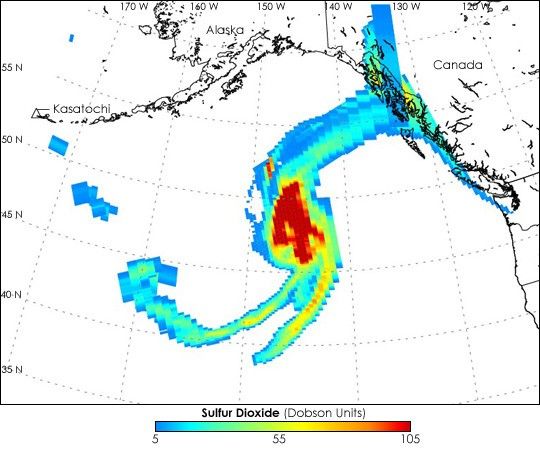
OMI captured this image on August 10, 2008. By this time, the sulfur dioxide cloud had traveled southeast toward the Canadian-United States border. The most densely concentrated portion of the cloud, containing up to 105 Dobson Units of sulfur dioxide, is dark red. A Dobson Unit is a measure of the concentration of the gas in a 15-kilometer tall column of the atmosphere. If you could compress all the sulfur dioxide in that column of the atmosphere into a flat layer at the Earth’s surface (at 0 degrees Celsius), one Dobson Unit of the gas would be 0.01 millimeters thick, and it would contain 0.0285 grams of sulfur dioxide per square meter. Lesser, though still significant amounts of sulfur dioxide trail behind the cloud from the volcano and arch forward into Canada and Washington. (Note that the scales on the large images are logarithmic, showing the natural log of column sulfur dioxide concentration in Dobson Units.)
Because the cloud may be associated with otherwise unseen ash, airlines canceled flights or diverted around the cloud. Fine volcanic ash can clog jet engines, causing them to stall. The ash also damages windshields and metal on the plane. As of August 11, Alaska Airlines had cancelled 44 flights to avoid the ash, affecting some 5,200 passengers, said Reuters. Because the volcano is located in a remote, uninhabited region, the eruption caused no further damage.
The OMI instrument is a Dutch-Finnish Instrument, provided to the EOS/Aura mission by the Netherlands and Finland.
References & Resources
- References
- Alaska Volcano Observatory. (2008, August 11). Kasatochi Activity. Accessed August 11, 2008.
- Rosen, Y. and Chiacu, D. (2008, August 11). Alaska Airlines cancels 44 flights over volcanic ash. Reuters. Accessed August 11, 2008.
NASA OMI image courtesy Simon Carn, Joint Center for Earth Systems Technology (JCET), University of Maryland Baltimore County (UMBC). Caption by Holli Riebeek.





