














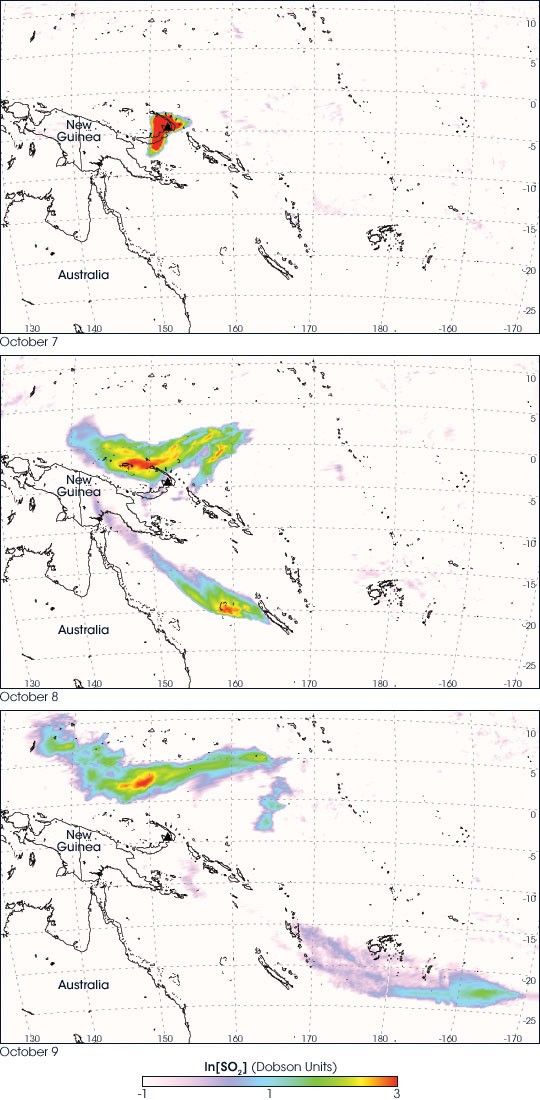
On October 7, 2006, Rabaul Volcano on the northeastern tip of New Britain produced a large-scale eruption. According to ReliefWeb, the eruption shook windows and rained heavy ash and small stones on the city of Rabaul as authorities declared a state of emergency. Besides volcanic ash and steam, the eruption produced sulfur dioxide. Densely concentrated over the island of New Britain the day of the eruption, the sulfur dioxide dispersed over the next two days.
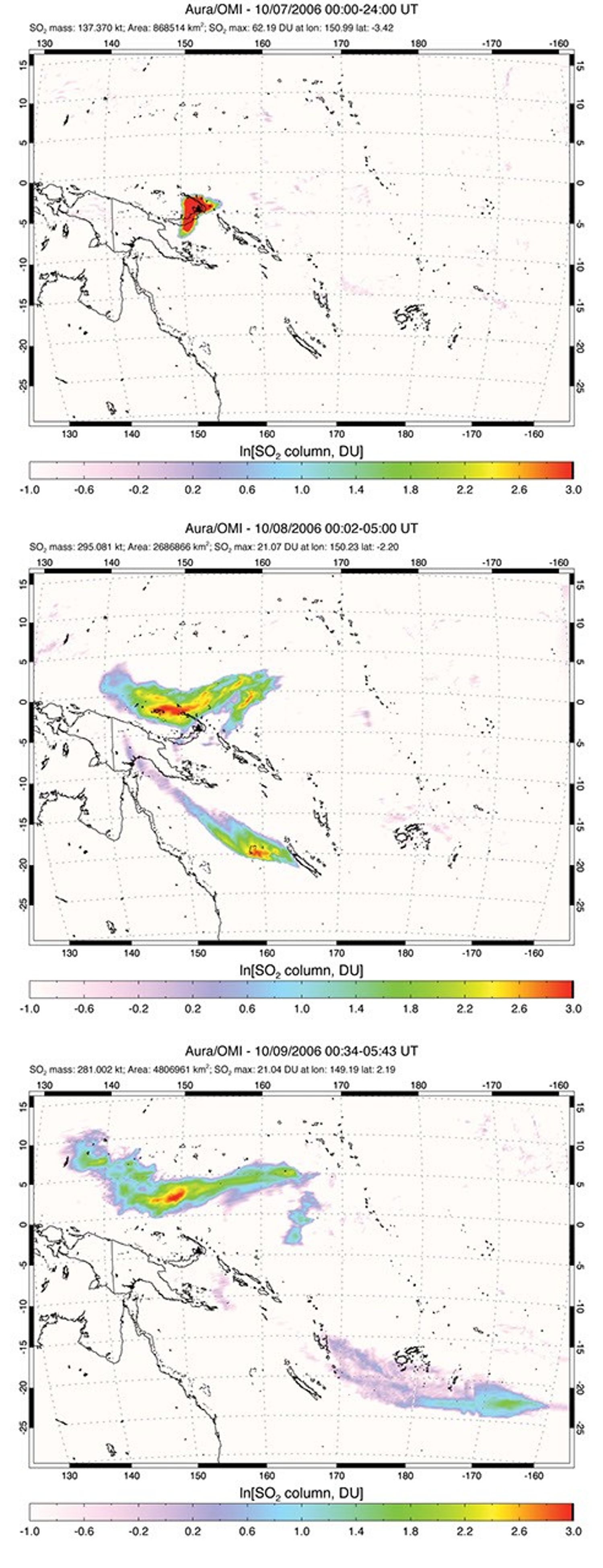
These images show the concentration of sulfur dioxide in the air column from October 7-9, 2006, as measured by the Ozone Monitoring Instrument (OMI) on NASA’s Aura satellite. On October 7, high concentrations of sulfur dioxide (red) linger just over the island. By October 8, the original plume had split into two clouds, one spreading northwest and one spreading southeast. On the third day, the amount of gas had decreased, but a core of very high values remained in the northern part of the plume.
The sulfur dioxide concentrations are shown using a logarithmic color scale. On a logarithmic scale, the values increase exponentially, rather than linearly. The units measured are Dobson Units. If all sulfur dioxide in the air column the satellite observed were flattened into a thin layer at the surface of the Earth, one Dobson Unit would make a layer of pure sulfur dioxide 0.01 millimeters thick, assuming the temperature was 0 degrees Celsius.
High concentrations of sulfur dioxide can lead to respiratory illnesses, especially in children and the elderly. It can also worsen heart and lung diseases. Sulfur dioxide also increases acid rain, damaging buildings, soils, and crops. Fortunately for the residents of New Britain, the sulfur dioxide cloud moved away from the island within a couple days. Large volcanic eruptions, such as the eruption of Mt. Pinatubo in 1991, can spew enough sulfur dioxide into the atmosphere to cool the climate for several years. Chemical reactions convert the gas into sulfate particles, which reflect sunlight.
OMI was added to the Aura satellite as part of a collaboration between the Royal Netherlands Meteorological Institute (KNMI), the Netherlands’ Agency for Aerospace Programs and the Finnish Meteorological Institute. KNMI is the Principal Investigatorinstitute. The sensor tracks global ozone change and monitors aerosols in the atmosphere.
References & Resources
NASA image courtesy Simon Carn, Joint Center for Earth Systems Technology (JCET), University of Maryland Baltimore County (UMBC)