








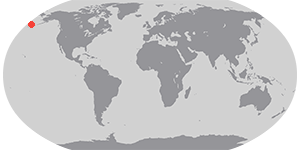


On July 12, 2008, Okmok Volcano, in Alaska’s Aleutian Islands erupted, releasing a plume of ash and steam. Besides emissions visible to human eyes, Okmok also released sulfur dioxide, a gas our eyes cannot see, but which can affect both human health and climate.
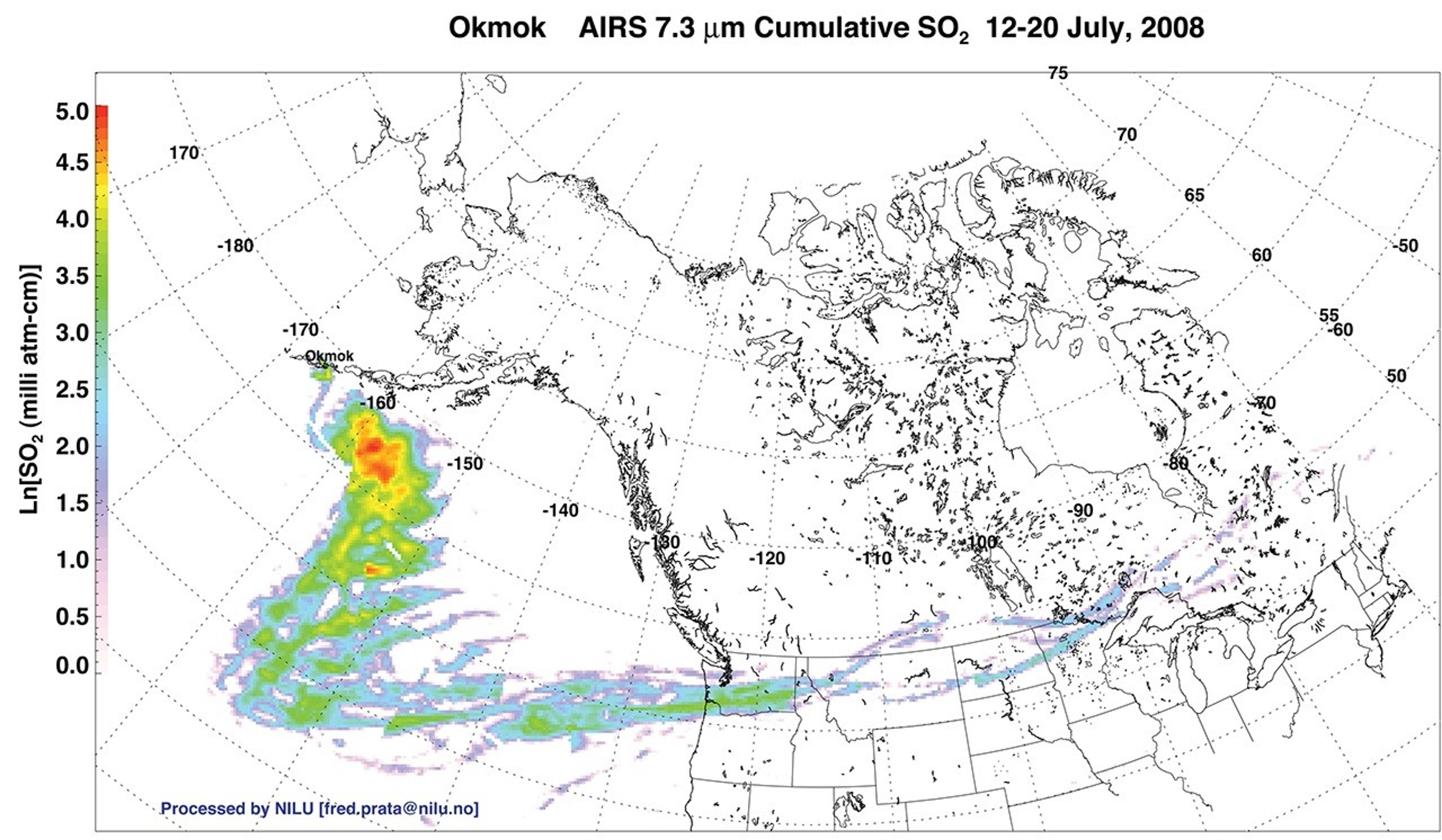
The Atmospheric Infrared Sounder (AIRS) instrument on NASA’s Aqua satellite measured the sulfur dioxide from Okmok Volcano from July 12-20, 2008. This image shows the estimated sulfur dioxide at altitudes around 16 kilometers (10 miles) released by the volcano over that time span, with red indicating the highest levels, and pale pink indicating the lowest. The sulfur dioxide was most intense southeast of the volcano, but lower levels spread both to the south and east, forming a large L shape, and spreading over parts of the continental United States and Canada.
To estimate the sulfur dioxide, Fred Prata of the Norwegian Institute for Air Research NILU examined the amount of thermal infrared (heat) radiation with wavelengths around 7.3 microns that AIRS detected coming from Earth. Sulfur dioxide absorbs radiation with that wavelength very strongly, preventing it from escaping to space. So when the gas is present in the atmosphere, the temperature that AIRS detects at that wavelength drops. Because thermal infrared energy is detectable day or night, Okmok emissions could be observed at all times of day.
Near the Earth’s surface, sulfur dioxide poses hazards, including aggravation of respiratory ailments, impaired visibility, and acid rain. In the presence of sunlight, sulfur dioxide can also mix with oxygen and water vapor to produce volcanic smog, or vog. The sulfur dioxide measured by AIRS, however, occurred above 16 kilometers. At higher altitudes, sulfur dioxide can affect climate. At high altitudes, oxidation transforms this gas into sulfate aerosol particles. The particles create a bright haze that reflects sunlight back into space, preventing it from reaching the Earth.
References & Resources
Image courtesy Fred Prata, NILU. Caption by Michon Scott and Rebecca Lindsey.