
























On January 1, 2008, Chile’s Llaima Volcano erupted, raining ash on the local wilderness park and sending a column of smoke skyward. Although no injuries or damage were reported, the eruption forced the evacuation of dozens of tourists from the volcano’s base, according to Reuters News Service.
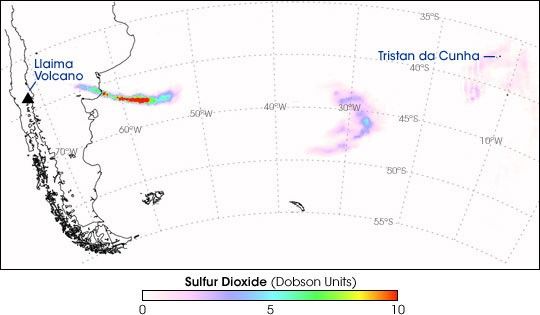
In addition to volcanic ash, Llaima’s eruption released a plume of sulfur dioxide. The initially intense plume thinned as it moved eastward. On January 4, the plume passed over Tristan da Cunha, a remote archipelago in the South Atlantic Ocean. This image, acquired by the Ozone Monitoring Instrument (OMI) on NASA’s Aura satellite, shows the progress of that plume from January 2-4, 2008. In this image, red indicates the greatest concentrations of sulfur dioxide and lavender-pink indicates the lowest concentrations. OMI measures the total column amount of sulfur dioxide in Dobson Units. If you compressed all the sulfur dioxide in a column of the atmosphere into a flat layer at standard temperature (0 degrees Celsius) and pressure (1 atmosphere), a single Dobson Unit of sulfur dioxide would measure 0.01 millimeters in thickness and would contain 0.0285 grams of sulfur dioxide per square meter.
Sulfur dioxide can combine with water to make a highly reflective haze of sulfuric acid. As this haze reflects sunlight away from Earth, a substantial eruption, such as the 1991 eruption from Mount Pinatubo, can have a cooling effect on the planet. OMI measurements indicated that the Llaima eruption produced three orders of magnitude less sulfur dioxide than Pinatubo, and so was not expected to have a significant effect on climate.
Llaima Volcano is a stratovolcano—a steep-sloped cone composed of alternating layers of solidified ash, hardened lava, and rocks ejected by previous eruptions. It is one of Chile’s largest and most active volcanoes.
References & Resources
NASA image courtesy Simon Carn, Joint Center for Earth Systems Technology (JCET), University of Maryland Baltimore County (UMBC). The OMI instrument is a Dutch-Finnish Instrument, provided to the EOS/Aura mission by The Netherlands and Finland. Text by Simon Carn and Michon Scott.





