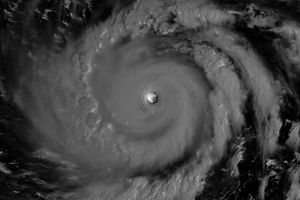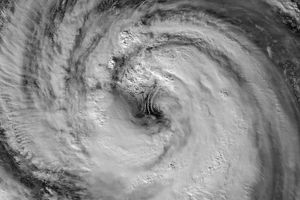



























Typhoon Haitang has been gradually building up strength in the northwest Pacific ocean several hundred kilometers from the Mariana Islands. This image was captured by the Moderate Resolution Imaging Spectroradiometer (MODIS) on the Aqua satellite at 04:10 UTC on July 14, 2005 (20:10 Eastern Daylight Time on July 13, 2005). At this time, the typhoon was just beginning to acquire the spiral pattern of a tropical cyclone, with winds reaching 140 kilometers per hour (75 knots).
Haitang was heading roughly westward at around 22 km/hr (12 knots) towards Luzon. However, its path is predicted to swing gradually northward to take it north of Taiwan and ultimately into the Chinese coastline near Shanghai. If the typhoon continues to strengthen according to predictions, it will have steady winds as high as 220 km/hr (120 knots) when it makes landfall. However, predicting hurricane strength and intensity remains an inexact science, so communities throughout the potentially affected area keep a wary eye on this threatening storm.
References & Resources
NASA image created by Jesse Allen, Earth Observatory, using data obtained from the MODIS Rapid Response team.