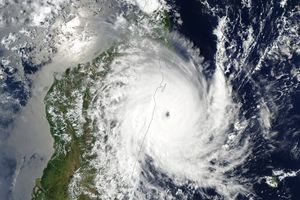

















Taiwan suffered a direct hit from Typhoon Haitang on the afternoon of Monday July 18, 2005 local time with sustained winds reported at 184 kph (114 mph) by the Taiwan Central Weather Bureau. The storm cut directly across the northcentral part of the island and after crossing the Taiwan Straits is expected to make landfall again on the southeast coast of China.
This image shows the storm at 03:59 UTC on the 17th ofJuly as it approaches Taiwan. Rain rates in the center of the swath are from the TRMM Precipitation Radar (PR), while those in the outer portion are from the TRMM Microwave Imager (TMI). The rain rates are overlaid on infrared (IR) data from the TRMM Visible Infrared Scanner (VIRS). The PR shows a small, well-defined eye surrounded by tight concentric bands of moderate (green) to heavy (red) rain, especially to the northeast of the center. These features are indicative of a mature intense cyclone. At the time of this image, Haitang's sustained winds were estimated to be 140 knots (161 mph) by Joint Typhoon Warning Center, making it a Category 5 super typhoon.
Launched in 1997, the Tropical Rainfall Measuring Mission (TRMM) satellite has served as a valuable platform for monitoring tropical cyclones. TRMM is a joint mission between NASA and the Japanese space agency JAXA.
References & Resources
Images produced by Hal Pierce (SSAI/NASA GSFC) and caption by Steve Lang (SSAI/NASA GSFC).