





















The Tropical Rainfall Measuring Mission (TRMM) satellite has providedsome remarkable images of Super Typhoon Maemi in the western Pacific fromits organization into a minimal typhoon well east of the Philippinesto its height as a super typhoon with winds over 155 mph as it was approachingthe southern Ryuku Islands. During the storm’s most intense phase,TRMM wasable to capture the evolution of Maemi’s eyewall structure as it wasstarting to undergo a process known as "eyewall replacement," whereby twoconcentric eyewalls are present before the outer eyewall collapses downto replace the original inner eyewall. This process can occur in veryintense typhoons and hurricanes.
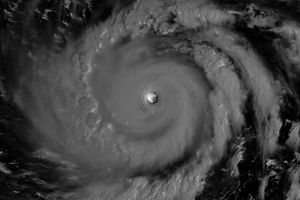
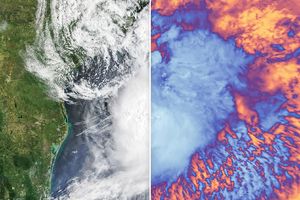
The first image (top two panels) was taken at 10:58 UTC on 10 September2003, just as Maemi was approaching the southern Ryuku Islands. At thattime, Maemi was classified as a Category 5 super typhoon by the JointTyphoon Warning Center with sustained winds estimated at 170 mph. Theleft panel shows an infrared (IR) image from the TRMM Visible InfraredScanner (VIRS). In it, Maemi appears very symmetrical with a well-definedeye and good cirrus outflow. In the right panel, rainfall rates from theTRMM Precipitation Radar (PR) and TRMM Microwave Imager (TMI), whichcontains the center of the storm, are overlaid on the VIRS data. Thoughthe heaviest rainfall rates (darker reds) are located on the northwest side ofthe eyewall, moderate (green) to intense (darker reds) rainfall rates arecontained throughout a well-defined tight inner eyewall. This inner coreis surrounded by a ring of minimal rainfall rates with a broader band ofmoderate to intense rainfall outside of that.
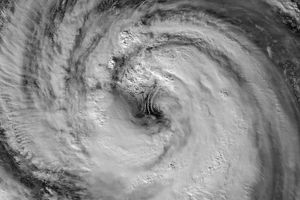
The next image (lower panels) was taken almost 24 hours later at 10:02 UTCon September 11. Again the VIRS IR image (left panel) shows a symmetricalstorm with an even smaller well-defined eye and a broad cirrus outflow. Therainfall structure (right panel) is now very different, however. It showsthat the innermost core of rainfall associated with the original eyewall,has weakened significantly. Instead, a new second eyewall, shown by thesharp ring of moderate (green areas) to intense (darker red areas) rainfallratesfurther out from the center, is emerging and has contracted towards thecenter though ultimately it would not replace the inner the eyewall. Atthe time of the second images, Maemi had winds estimated at 155 mph and hadjust passed the southern Ryuku Islands.
TRMM is a joint mission between NASA and the Japanese space agency NASDA.
References & Resources
Image produced by Hal Pierce (SSAI/NASA GSFC) and caption by Steve Lang (SSAI/NASA GSFC).