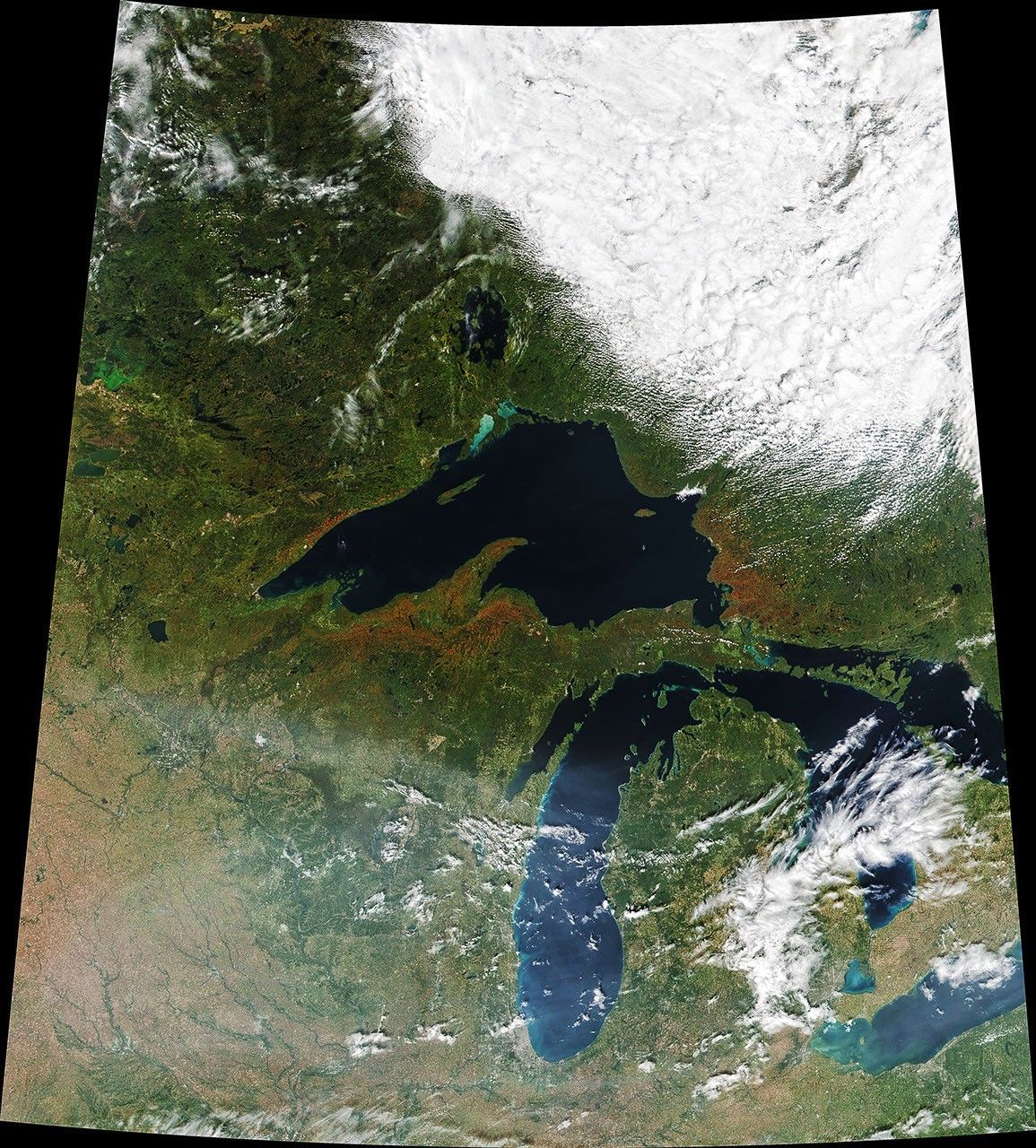

















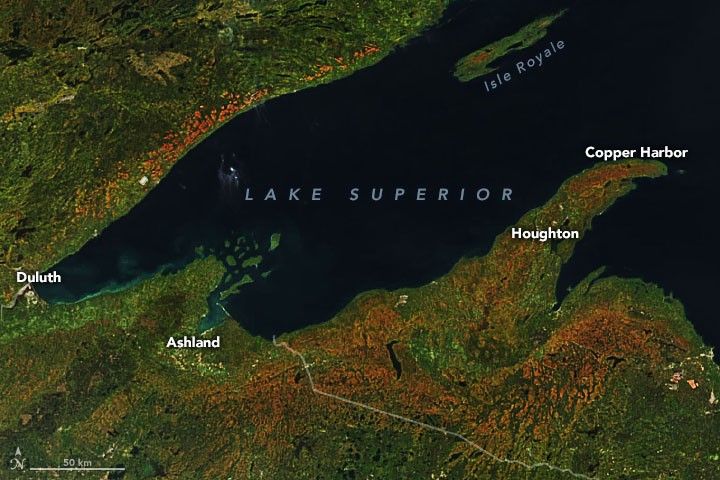
Minnesota, Wisconsin, and Michigan are typically among the first parts of the contiguous United States to experience autumn color. Fall 2020 was no exception.
Aided by a period of chilly weather, fall foliage was peaking in the region’s forests in late September. On September 22, 2020, the Visible Infrared Imaging Radiometer Suite (VIIRS) on NOAA-20 acquired this image of the area around Lake Superior, which is rich with aspen, birch, maple, basswood, and other deciduous hardwood trees.
In autumn, the leaves on deciduous trees change colors as they lose chlorophyll, the molecule that plants use to synthesize food. Chlorophyll makes plants appear green because it absorbs red and blue sunlight as it strikes leaf surfaces. It is not a stable compound and plants have to continuously synthesize it to keep their leaves green—a process that requires ample sunlight and warm temperatures. When temperatures drop and days shorten, levels of chlorophyll drop as well.
As green chlorophyll fades, other leaf pigments—carotenoids and anthocyanins—show off their colors. Carotenoids absorb blue-green and blue light, appearing yellow; anthocyanins absorb blue, blue-green, and green light, appearing red.
As explained by the U.S. Forest Service, certain species of trees produce certain colors. Oaks generally turn red, brown, or russet; aspen and yellow-poplar turn golden. Maples differ by species. Red maple turns brilliant scarlet; sugar maple, orange-red; and black maple, yellow. Leaves of some trees, such as elms, simply become brown.
References & Resources
- Minnesota Department of Natural Resources When and why leaves change color. Accessed September 29, 2020.
- National Forest (2018, September 14) Fall Color Begins in the Spring. Accessed September 29, 2020.
- National Weather Service Fall Colors Report. Accessed September 29, 2020.
- Smoky Mountains Fall Foliage Prediction Map. Accessed September 29, 2020.
- The Washington Post (2019, October 9) Fantastic fall foliage. Accessed September 29, 2020.
- The Washington Post (2020, September 24) Coldest weather of the season to dive into eastern U.S. next week as fall colors begin to burst. Accessed September 29, 2020.
- U.S. Forest Service Science of Fall Colors Science of Fall Colors. Accessed September 29, 2020.
- U.S. Forest Service Science of Fall Colors The Chemistry Behind the Fall Color. Accessed September 29, 2020.
NASA Earth Observatory image by Joshua Stevens , using VIIRS data from NASA EOSDIS/LANCE and GIBS/Worldview and the Joint Polar Satellite System (JPSS). Caption by Adam Voiland .