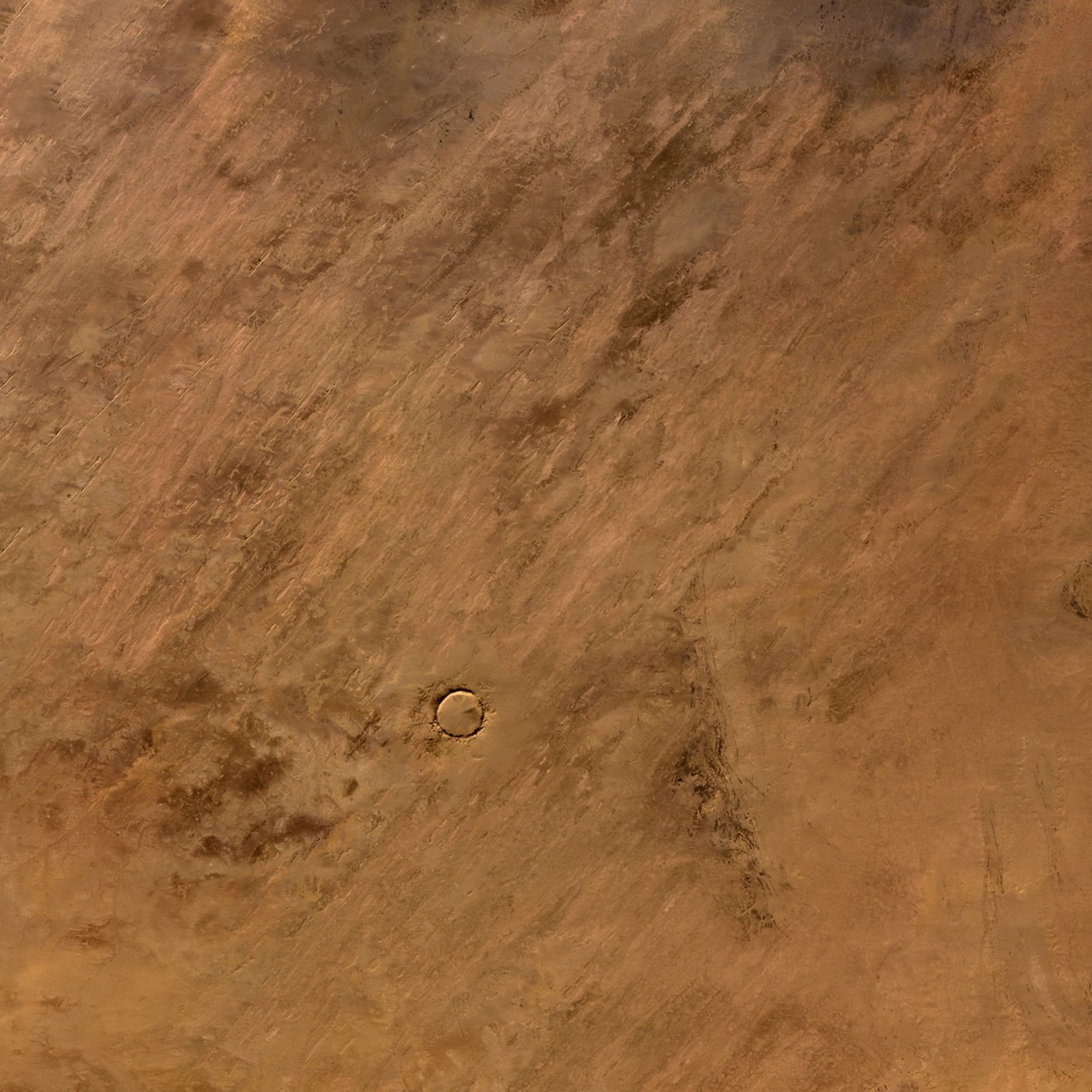















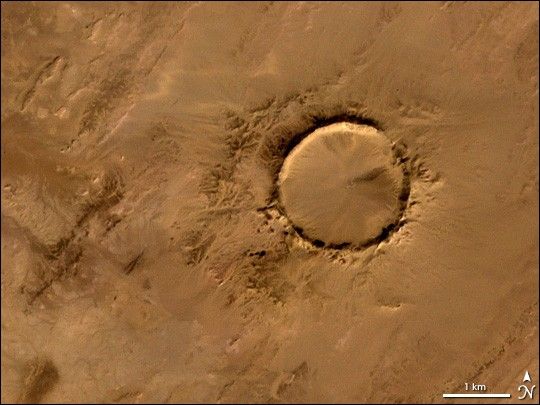
Deep in the Sahara Desert lies a crater. Nearly a perfect circle, it is 1.9 kilometers (1.2 miles) wide, and sports a rim 100 meters (330 feet) high. The crater sits in a vast plain of rocks so ancient they were deposited hundreds of millions of years before the first dinosaurs walked the Earth. Modern geologists long debated what caused this crater, some of them favoring a volcano. But closer examination of the structure revealed that the crater’s hardened “lava” was actually rock that had melted from a meteorite impact.
Advanced Spaceborne Thermal Emission and Reflection Radiometer (ASTER) on NASA’s Terra satellite captured this image of Tenoumer Crater in Mauritania on January 24, 2008. In this simulated-true-color image, the arid landscape appears in varying shades of brick red, brown, and tan. The crater’s outline is unmistakable, yet it doesn’t necessarily look like a crater; the light and shadows make it look more as if someone pressed a giant cookie cutter into the rock. In this image, the sunlight shines from the southeast (lower right), and the bright arc along the northwestern part of the crater is where the crater walls slope up to the rim. Around the perimeter, the relatively steep walls cast dark shadows.
Although it resides in ancient rock, Tenoumer is geologically young, ranging in age between roughly 10,000 and 30,000 years old. Once Tenoumer’s origin as an impact crater was understood, geologists began to wonder whether it resulted from a multiple impact event. Tenoumer and two other craters, named Temimichat-Ghallaman and Aouelloul, occur along an almost perfectly straight line. A 2003 study tried to resolve the issue by examining the ages of these craters. By looking at chemical compositions of rocks, geologists can estimate when they formed. Examination of Tenoumer and Aouelloul craters showed that they formed at different times and therefore could not have resulted from the same impact event.
References & Resources
- References
- Storzer, D., Sélo, M., Latouche, L., and Fabre, J. (2003). The age of Tenoumer crater, Mauritania, revisited (abstract #1183). Thirty-fourth Lunar and Planetary Science Conference.
- Pratesi, G., Morelli, M., Rossi, A.P., and Ori, G.G. (2005). Chemical compositions of impact melt breccias and target rocks from the Tenoumer impact crater, Mauritania. Meteoritics & Planetary Science. 40(11), 1653-1672.
NASA image created by Jesse Allen, using data provided courtesy of NASA/GSFC/METI/ERSDAC/JAROS, and U.S./Japan ASTER Science Team.