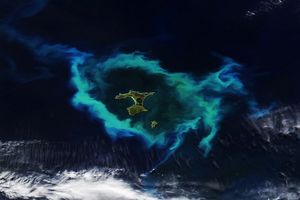



















Over the past several years, dense clouds of phytoplankton (microscopicplants that live in water) have appeared in the Bering Sea each summer.One class of phytoplankton are particularly easy to spot from overhead.Called coccolithophores, these phytoplankton grow calcium-rich shells. These shells are bright white and turn the waterwhere they grow a milky blue.
The Sea-viewing Wide Field-of-view Sensor (SeaWiFS) captured this image ofcoccolithophores off the coast of Alaska on September 13 and 14, 2000. (The BeringSea straddles the International Dateline, so the left side of the image isthe 14th while the right is the 13th.) The bloom covers approximately 400,000square kilometers (154,000 square miles). Swirls of water with varying shades showocean currents and eddies. In general, the brighter the water, the higher theconcentration of coccolithophores. SeaWiFS has been taking pictures of this areasince 1997. Follow these links to see more images:
June 27, 2000
April 29, 2000
Changing Currents Colorthe Bering Sea a new Shade of Blue (several images from 1998)
References & Resources
Image provided by the SeaWiFS Project, NASA/Goddard Space Flight Center, and ORBIMAGE.