



















September 20, 2006-September 19, 2022
The Caspian Sea’s Shrinking Coastline
Measured by surface area, the Caspian Sea is Earth’s largest inland water body, spanning about 371,000 square kilometers (143,200 square miles). Measured by economic, social, and biodiversity standards, it is priceless.
The Caspian Sea supports a commercially important fishery, supplies water for agriculture, and provides recreation and work opportunities for people living nearby. Its waters are also home to several threatened species, including an estimated 90 percent of the planet’s last-remaining sturgeon.
In the northern Caspian, shallow waters teem with mollusks, crustaceans, fish, and birds. Seals raise their pups on winter ice that usually only forms in this part of the lake. And all rely on a healthy water level for their existence. However, the Caspian Sea is rapidly shrinking.
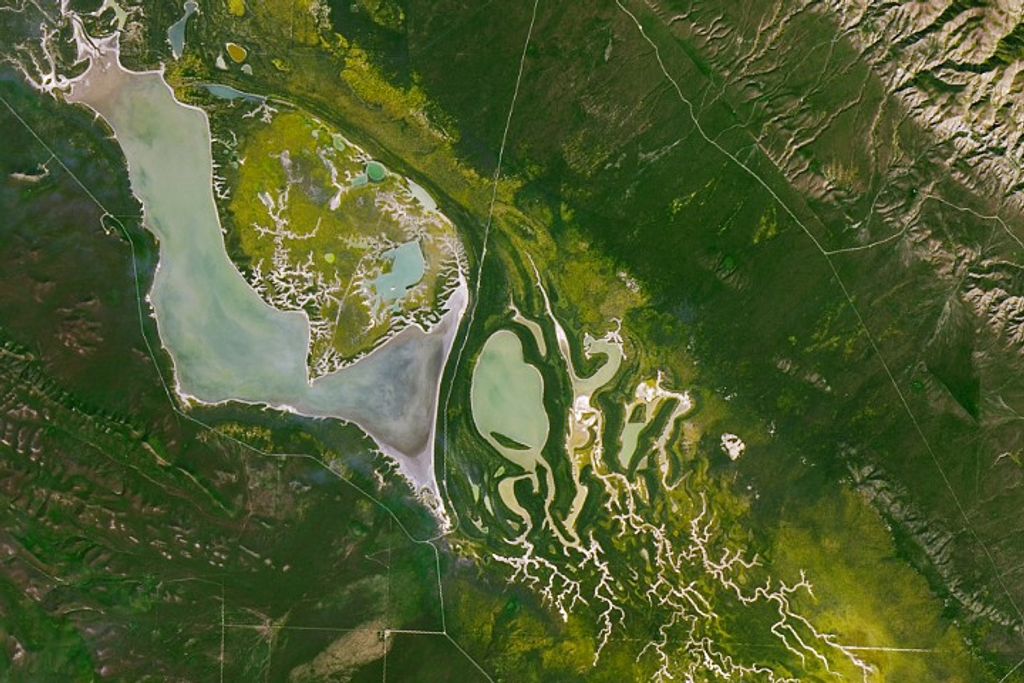
On September 19, 2022, the Moderate Resolution Imaging Spectroradiometer (MODIS) on NASA’s Aqua satellite acquired this natural-color image (right) of the northern Caspian Sea. Part of the sprawling Volga River Delta (dark green) is visible along the left side of the image. Sediments, carried into the lake by the Volga and stirred up from the shallow lakebed by currents, color the water with swirls of light green and tan. Light gray areas along the shoreline and patches of white to the southeast are likely salt and other minerals left behind after evaporation.
For comparison, the left image was acquired by Terra MODIS on September 20, 2006. There is no light-colored, salt-laden halo along the northern shore, and only a relatively small salt crust in the east and south. Water filled the serpentine area that, twelve years later, has become a thick mineral crust.
Radar altimetry data collected by multiple satellites and compiled by NASA’s Global Water Monitor indicate that the Caspian’s water levels have been dropping since the mid-1990s. Other research suggests that the decline could continue as climate change brings warmer air temperatures and increased evaporation.
In one study, scientists ran several models to estimate future water losses due to climate change. They projected that by 2100, water levels in the Caspian Sea could drop by another 8 to 30 meters (26 to 98 feet). The use or diversion of water for human activity is also an important driver of water loss in the Caspian. Accounting for this factor adds up to 7 meters (23 feet) of further loss, the scientists found.
References & Resources
- Britannica Caspian Sea. Accessed October 7, 2022.
- Koriche, S.A. et al. (2021) The fate of the Caspian Sea under projected climate change and water extraction during the 21st century. Environmental Research Letters 16, 094024.
- Mitrofanov, I.V. and Mamilov, N.Sh. (2015) Fish diversity and fisheries in the Caspian Sea and Aral–Syr Darya basin in the Republic of Kazakhstan at the beginning of the 21st Century. Aquatic Ecosystem Health & Management 18 (2), 160–170.
- MODIS Image of the Day (2022, September 15) The Shrinking Coastline of the Caspian Sea. Accessed October 7, 2022.
- NASA Earth Observatory (2021, November 6) The Caspian’s Shallow North.
- Natural History (2011–2012) Fate of the Caspian Sea. Accessed October 7, 2022.
- SeafoodSource (2021, February 12) After long commercial fishing shutdown, anchovy showing up in abundance in Caspian Sea. Accessed October 7, 2022.
- Worldview (2014, May 19) The Strategic Importance of the Caspian Sea. Accessed October 7, 2022.
NASA Earth Observatory images by Lauren Dauphin, using MODIS data from NASA EOSDIS LANCE and GIBS/Worldview . Story by Joanne Howl/ MODIS Image of the Day , adapted for Earth Observatory by Kathryn Hansen.





