












The Galapagos archipelago is located about 1,000 kilometers (600 miles) from continental Ecuador. It includes more than 125 islands, islets, and rocks populated by a diversity of wildlife. Charles Darwin’s book, The Voyage of the Beagle, cast a spotlight on the Galapagos, which he called “a little world within itself, or rather a satellite attached to America, whence it has derived a few stray colonists.”
It was this little world that would revolutionize scientific understanding of biology and lead to Darwin’s On the Origin of Species, which would come to be known as the foundation of evolution.
“The natural history of these islands is eminently curious, and well deserves attention,” Darwin wrote. “Most of the organic productions are aboriginal creations, found nowhere else; there is even a difference between the inhabitants of the different islands; yet all show a marked relationship with those of America, though separated from that continent by an open space of ocean, between 500 and 600 miles in width.”
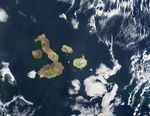
The Moderate Resolution Imaging Spectroradiometer (MODIS) on NASA’s Aqua satellite captured this natural-color image of the Galapagos on October 8, 2016. The archipelago’s largest islands are visible amid patches of clouds. Circular volcanic cones stand atop several islands.
The islands formed at the meeting point of three tectonic plates—the Nazca, Cocos, and Pacific—and they are situated at the crossroads of three major Pacific currents. The Galapagos is home to nearly 9,000 species, many of them rare and unique to the Islands. They include giant tortoises, land iguanas, flightless cormorants, and the only species of penguin in that lives north of the equator.
After being hunted nearly to extinction, the island’s giant tortoises are protected. Still, non-native species on the island threaten to overturn balance in the ecosystem. For instance, wild dogs and cats can compete with native species for food or prey on them, according to the Galapagos Preservation Society, which works to educate residents on looking after their pets in order to protect native species. The group has been active in building fences to keep in domestic animals.
References & Resources
- NASA Earth Observatory (2005, May 13) Fernandina Volcano, Galapagos Islands.
- NASA Earth Observatory (2009, February 13) Wolf Volcano, Galapagos Islands.
- NASA Earth Observatory (2012, October 28) Isla Santiago, Galapagos Islands.
- Smithsonian Institution Global Volcanism Program. Wolf. Accessed October 31, 2016.
- UNESCO (2016) Galapagos Islands.
- White, W.M. (2001, January 23) Galapagos Geology on the Web. Department of Earth & Atmospheric Sciences, Cornell University. Accessed October 31, 2016.
NASA image by Jeff Schmaltz, LANCE/EOSDIS Rapid Response. Caption by Pola Lem.