

















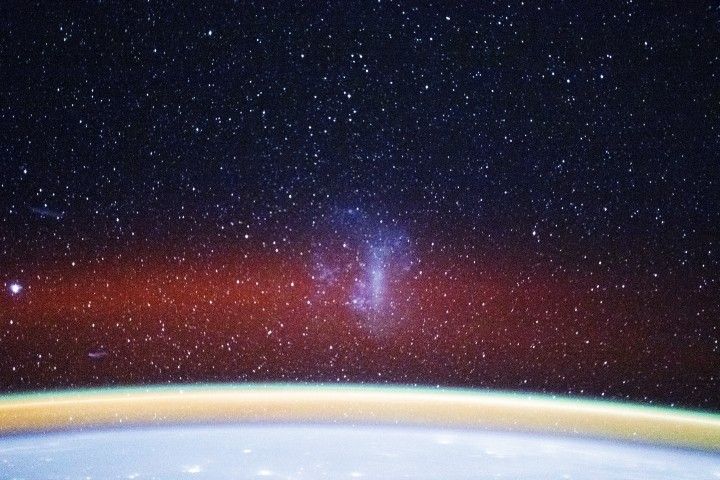
From the International Space Station, astronauts gaze upon a vast sea of stars, the view almost entirely unencumbered by Earth’s atmosphere. Their perspective on outer space, as it turns out, extends beyond the Milky Way.
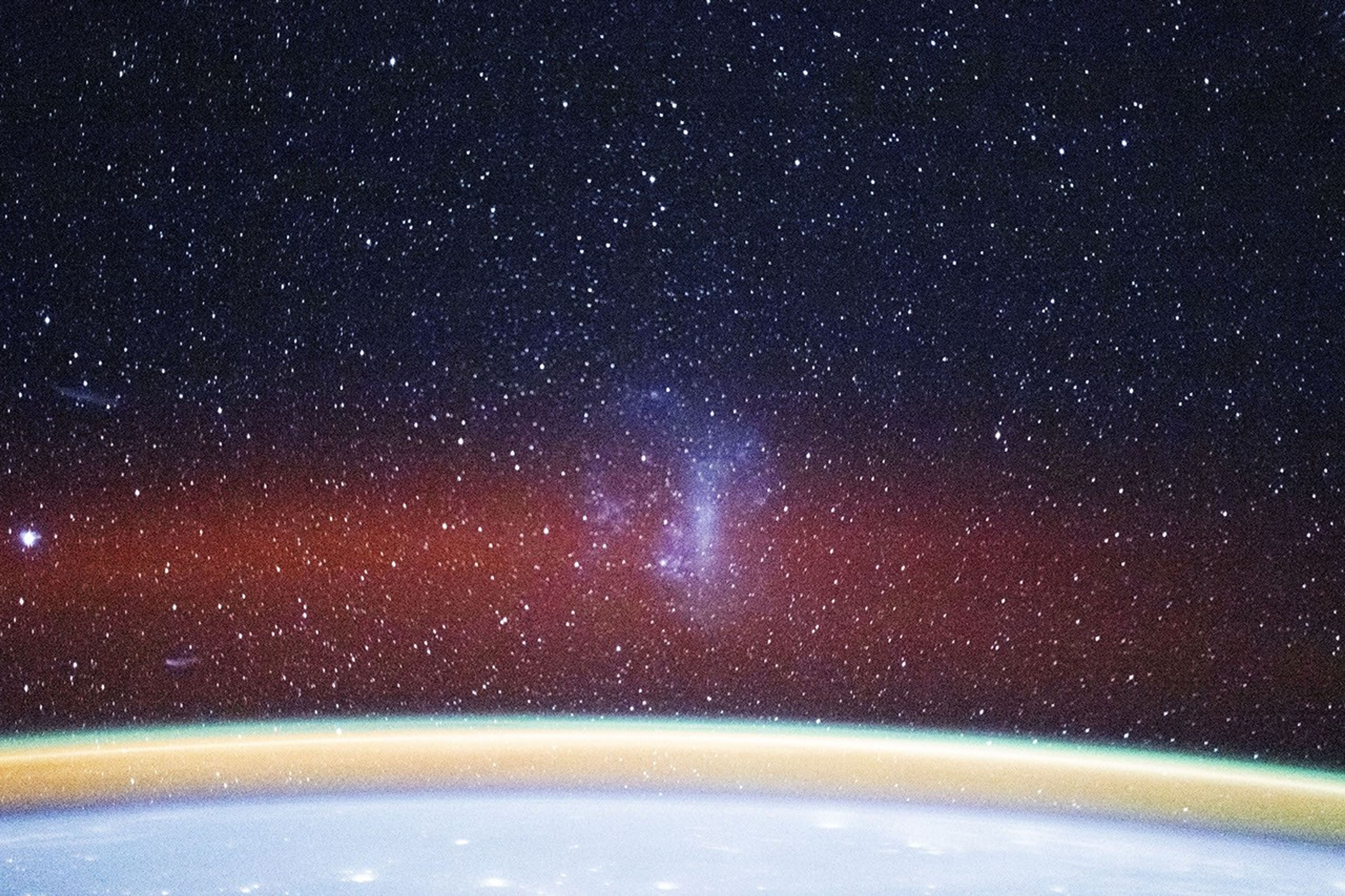
Located about 160,000 light-years away, the Large Magellanic Cloud (LMC) is an irregular dwarf galaxy consisting of billions of stars. It appears as a bright smudge in this photo, which was taken by an astronaut aboard the station on November 28, 2025. Arcing across the bottom of the image is Earth’s limb, along with yellow, green, and diffuse red layers of airglow.
Skywatchers on Earth can also see this nearby galaxy from the Southern Hemisphere and from low Northern Hemisphere latitudes without optical aid. It is part of our Local Group, a galactic neighborhood about 10 million light-years across containing the Milky Way, Andromeda, and Triangulum galaxies, plus around 50 dwarf galaxies, including the LMC.
Although this parcel of space is visible with little or no technology, sophisticated instruments developed by NASA and others have captured extraordinary views of the LMC. Images from the Hubble Space Telescope, the Spitzer Space Telescope, and a combination of missions show its stars and nebulae in different wavelengths.
The LMC is a hotbed of star formation, giving astronomers excellent opportunities to study the life cycle of stars and space dust. A supernova in 1987—the nearest observed in hundreds of years—offered a close-up look at the death of a star and its aftermath. The powerful explosion blazed with the power of 100 million Suns for several months, and scientists observed a bright ring of gas around the exploded star for decades.
More recently, astronomers studied how vast quantities of dust were being forged in the supernova’s glowing remains. A portion of the material may be the source of astronomical new beginnings as building blocks for stars and planets.
Astronaut photograph ISS073-E-1198989 was acquired on November 28, 2025, with a Nikon Z9 digital camera using a focal length of 50 millimeters. It is provided by the ISS Crew Earth Observations Facility and the Earth Science and Remote Sensing Unit at NASA Johnson Space Center. The image was taken by a member of the Expedition 73 crew. The image has been cropped and enhanced to improve contrast, and lens artifacts have been removed. The International Space Station Program supports the laboratory as part of the ISS National Lab to help astronauts take pictures of Earth that will be of the greatest value to scientists and the public, and to make those images freely available on the Internet. Additional images taken by astronauts and cosmonauts can be viewed at the NASA/JSC Gateway to Astronaut Photography of Earth. Story by Lindsey Doermann.
References & Resources
- EarthSky (2025, October 14) Large and Small Magellanic Clouds shine in southern skies. Accessed December 16, 2025.
- EarthSky (2023, October 24) The Local Group is our galactic neighborhood. Accessed December 16, 2025.
- European Southern Observatory (2009, December 3) Magellanic Clouds ― irregular dwarf galaxies. Accessed December 16, 2025.
- NASA Science (2017, February 24) The Dawn of a New Era for Supernova 1987A. Accessed December 16, 2025.
- NASA Science (2013, January 23) Large Magellanic Cloud. Accessed December 16, 2025.
- NASA Space Place (2025, September 25) What Is a Supernova? Accessed December 16, 2025.