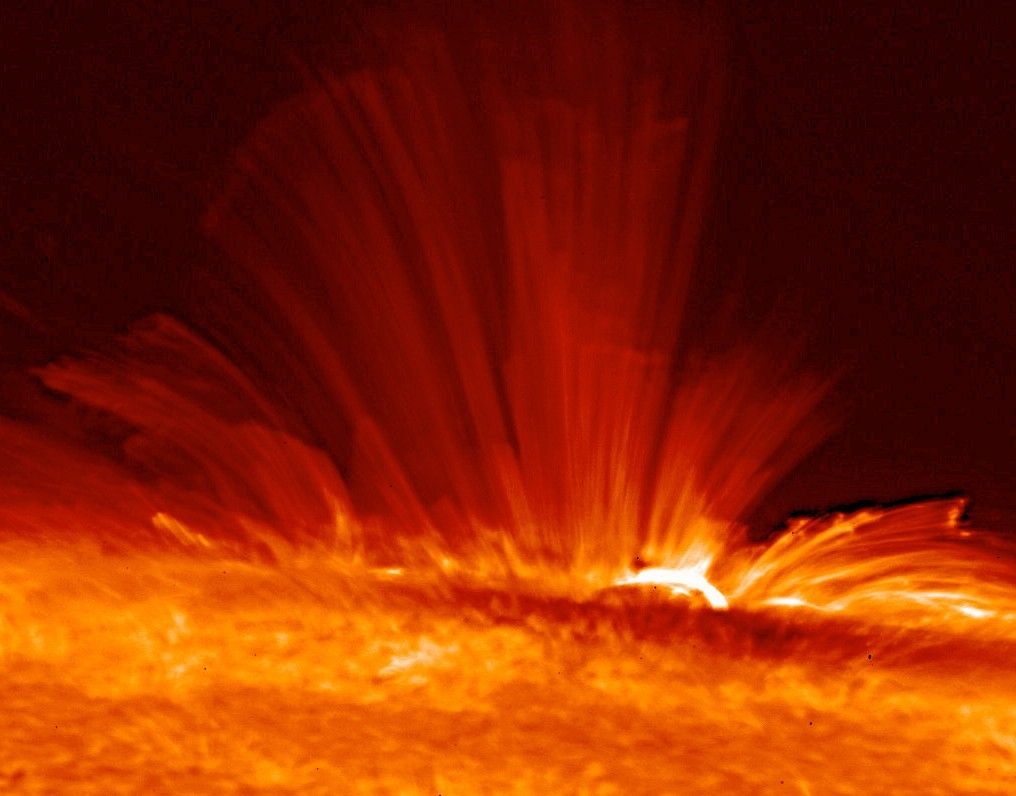
















Vivid orange streamers of super-hot, electrically charged gas (plasma) arc from the surface of the Sun, revealing the structure of the solar magnetic field rising vertically from a sunspot. The thin outer surface of the Sun, the corona, is shaped by a complex network of magnetic fields. These magnetic fields are strongest inside sunspots, and their effect on plasma is visible in this image. The gas is drawn along the lines of force in the sunspot’s magnetic field like iron filings gather around a magnet. At the edges of the sunspot, the curving field lines, and thus the plasma, bend over to reconnect with magnetic fields of opposite polarity.
This extremely detailed image of the Sun was taken by the Solar Optical Telescope on the newly launched Hinode spacecraft on November 20, 2006. It and other images, which NASA released for the first time on March 21, 2007, reveal that the Sun’s magnetic field is much more turbulent and dynamic than previously known. “For the first time, we are now able to make out tiny granules of hot gas that rise and fall in the sun's magnetized atmosphere,” said Dick Fisher, director of NASA's Heliophyics Division, Science Mission Directorate, Washington.
Hinode, Japanese for “sunrise,” was launched September 23, 2006, to study the Sun’s magnetic field and how its explosive energy propagates through the different layers of the solar atmosphere. “Hinode is showing how changes in the structure of the magnetic field and the release of magnetic energy in the low atmosphere spread outward through the corona and into interplanetary space to create space weather,’ said John Davis, project scientist from NASA’s Marshall Space Flight Center. Space weather involves the production of energetic particles (coronal mass ejections) and emissions of electromagnetic radiation (solar flares), which can black out long-distance communications over entire continents and disrupt global navigational systems.
Scientists believe that space weather is driven by changes in the magnetic fields around sun spots, but the exact mechanisms that trigger flares and solar storms remain a mystery. “By following the evolution of the solar structures that outline the magnetic field before, during and after these explosive events, we hope to find clear evidence to establish that magnetic reconnection is the underlying cause for this explosive activity,’ said Leon Golub of the Smithsonian Astrophysical Observatory. Hinode will allow scientists study solar storms and flares by revealing changes in the magnetic fields in unprecedented detail.
To read more about Hinode’s mission to study the Sun and to see additional images, please visit Hinode Mission to the Sun. Hinode is a collaborative mission led by the Japan Aerospace Exploration Agency and includes the European Space Agency and Britain's Particle Physics Astronomy Research Council.
References & Resources
Image courtesty Hinode, JAXA/NASA.