



















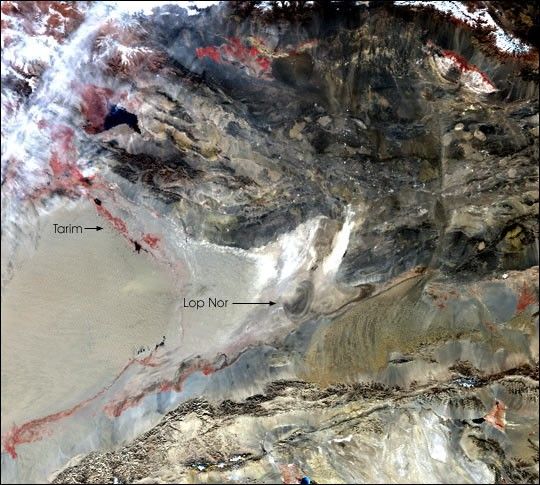
In the area at the very far eastern corner of China’s TaklimakanDesert, Lop Nor Lake was located up until some years ago. Lop Nor, alsocalled the “the heart of the heart” of Asia, was the placewhere the waters of the largest inner basin (i.e., not flowing into thesea) of the world—including the Tarim and Kum-daria Rivers—werecollected. Depending on the balance between rainfall water yield andevaporation, both position and size of the lake were strongly variable,thus giving rise to the legend of the Wandering Lake.
“Lop City” was the place where Marco Polo took his lastrest before facing the one-year long crossing of the Gobi Desert. Startingfrom the end of the 19th century, several explorers tried to find thelegendary place. One such explorer was Sven Hedin, who was commissionedby the Governor of Nanjing to lead an expedition to find the lake. In1937, the Swedish explorer published his book entitled The WanderingLake.
Comparing this very precise map from Sven Hedin’s book with theabove Moderate-resolution Imaging Spectroradiometer (MODIS) false-colorimage (acquired on October 28, 2001), one can find a faint sign on thesoil where the Lop Nor was located. This image, derived using acombination of MODIS’ near-infrared and red channels (vegetation inred), shows where the Tarim River waters currently end their flow.
The Wandering Lake does not exist anymore. The combination of climatechange and human exploitation of water resources for agriculture causedthe disappearance of the lake.
This image was processed by Telespazio, Earth Observation division,new products development facility in Rome, Italy. The MODIS sensor fliesaboard NASA’s Terra spacecraft, launched in December 1999.
References & Resources
Caption and image courtesy Luca Pietranera, Telespazio, Rome, Italy, based on data from the MODIS Science Team