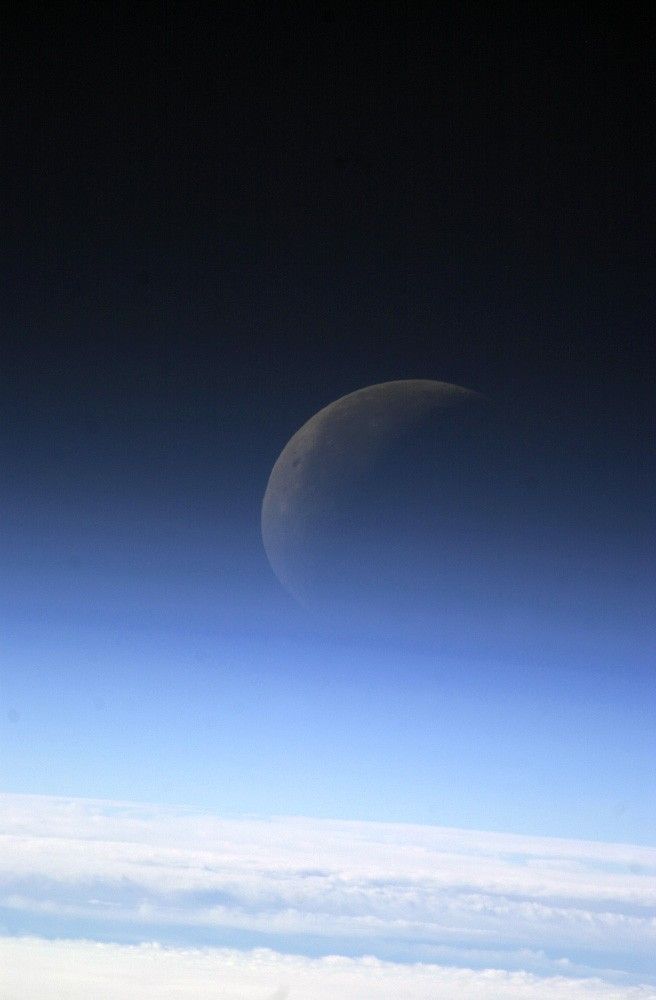

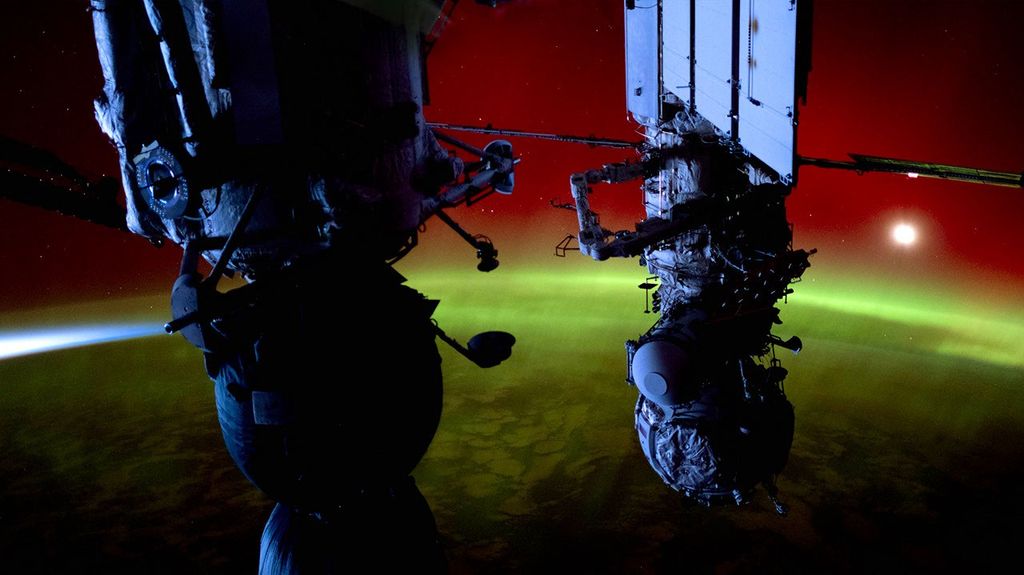














From a vantage point about 360 km (225 miles) over the Earth, Space Station crewmembers photographed the crescent moon through the upper layers of Earth’s atmosphere. At the bottom of the image, a closed deck of clouds is probably at about 6 km (3 miles). The shades of blue grading to black are caused by the scatter of light as it strikes gas molecules of the very low density upper atmosphere.
Models predict that emissions of carbon dioxide are causing the upper atmosphere to cool and contract, and therefore reduce the density of gases in the layer spanning from 90 to 649 km (60 to 400 miles) above the surface—known as the thermosphere. According to a study by the Naval Research Laboratory, the density of the thermosphere has decreased about 10 percent over the last 35 years. These findings are important both for space science and for Earth science. Spacecraft in orbit, such as the International Space Station, experience less drag and need fewer boosts to maintain their orbit. At the same time, space debris also remains in orbit longer, which increases hazards to spacecraft. Most importantly, the study validates models of the “greenhouse effect” of increased carbon dioxide release on the dynamics of the atmosphere.
References & Resources
Astronaut photograph ISS008-E-8951 was taken using a Nikon digital camera with an 800-mm lens and was provided by Julie A. Robinson, Earth Sciences and Image Analysis Laboratory (Lockheed Martin), Johnson Space Center. The International Space Station Program supports the laboratory to help astronauts take pictures of Earth that will be of the greatest value to scientists and the public, and to make those images freely available on the Internet. Additional images taken by astronauts and cosmonauts can be viewed at the NASA/JSC Gateway to Astronaut Photography of Earth .