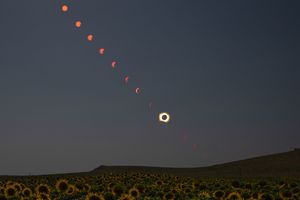

















On December 3, 2002, people in Australia received a rare 32-second celestial show as the Moon completely obscured the Sun, creating a ring of light. Solar eclipses provide experts an opportunity to study the Sun’s outer atmosphere, called the corona. This total eclipse was the first to cover Australian shores since 1976. The next is not predicted to occur for several more decades.
While people in Australia were observing the solar eclipse, the Solar and Heliospheric Observatory (SOHO) spacecraft also had its eye on the Sun. From its unique vantage point in space, scientists have been able to monitor the explosions on the Sun that can impact us here on Earth. This image combines a photograph of the solar eclipse with data taken by the Extreme Ultraviolet Imaging Telescope (EIT) instrument onboard the SOHO spacecraft. Additional NASA satellites, such as ACRIMSAT and SORCE, study the Sun’s energy output, and the effect it has on the Earth’s climate.
References & Resources
Image courtesy NASA/ESA