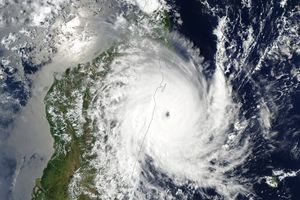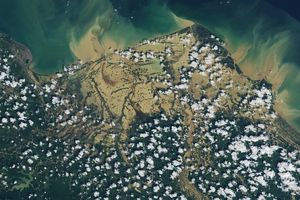
















Tropical Cyclone Favio came ashore on the coast of Mozambique in the morning of February 22, 2007. At the time it crossed the shoreline, Favio had lost some strength from its peak the previous day, but still had extremely powerful winds that measured around 203 kilometers per hour (126 miles per hour), according to the Tropical Storm Risk.com and Reuters AlertNet. The cyclone, the strongest recorded storm to hit Mozambique, was heading directly towards the Zambezi River valley region. This region suffered heavy rains associated with the onset of the monsoon, and severe flooding along the Zambezi River in mid-February killed dozens of people and forced more than a hundred thousand people to evacuate, according to reports from the International Federation of Red Cross and Red Crescent Societies posted online by ReliefWeb.
This photo-like image was acquired by the Moderate Resolution Imaging Spectroradiometer (MODIS) on the Terra satellite on February 22, 2007, at10:20 a.m. local time (8:20 UTC), just as the storm was coming ashore. The eye of the storm was just off the coast as MODIS observed the cyclone. Favio had the recognizable shape of a mature, southern hemisphere tropical cyclone, with spiral arms showing its clockwise rotation, and a well-defined eye with strong eyewall (inner ring) clouds.
The high-resolution image provided above is at MODIS’ full spatial resolution (level of detail) of 250 meters per pixel. The MODIS Rapid Response System provides this image at additional resolutions.
References & Resources
NASA image by Jeff Schmaltz, MODIS Rapid Response Team, Goddard Space Flight Center.