


























- Quicktime (.mov) format (1 MB)
- MPEG-1 (.mpg) format (1 MB)
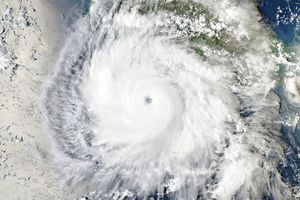
The island of Madagascar, which was hit by Cyclone Elita back on the29th of January, recently suffered a direct hit from Gafilo, a far morepowerful storm rated as an intense Category 5 Cyclone at the time itmade landfall on the island's northeast coastline. So far Gafilo hasleft 7 dead, 18 missing and up to 100,000 homeless on Madagascar.Gafilo began as a tropical depression back on the 29th of February 2004in the central Indian Ocean south of Deigo Garcia in the ChagosArchipelago. Two days later on the 2nd of March, it became a tropicalstorm and continued moving west. Gafilo strengthened into a Category 1cyclone the next day on the 3rd, and March 4th saw Gafilo continuing tointensify with winds increasing to 85 knots (98 mph) as estimated bythe Joint Typhoon Warning Center. On the 5th, Gafilo began a cycle ofrapid deepening with winds increasing to 125 knots (144 mph) making ita major Category 4 cyclone. It was now moving west-southwest headedstraight for Madagascar. The next day, on the 6th of March 2004,Gafilo struck the northeast coast of Madagascar near to the town ofAntalaha as a Category 5 cyclone, the highest possible rating, itssustained winds having further increased to an estimated 140 knots(161 mph). Ninety-five percent of Antalaha was reported destroyed.
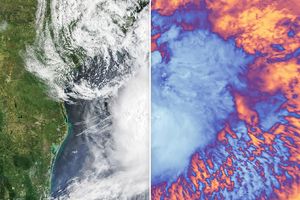
The Tropical Rainfall Measuring Mission (TRMM) satellite capturednumerous, impressive images of Cyclone Gafilo covering most of it'slife cycle as it traversed the western Indian Ocean. The first image (top left)was taken at 8:15 UTC on 4 March 2004. It shows the horizontaldistribution of rain rates as seen from above by the TRMM satellite.Rain rates in the center swath are from the TRMM Precipitation Radar(PR), the first and only precipitation radar in space, and rain ratesin the outer swath are from the TRMM Microwave Imager (TMI). Therain rates are overlaid on infrared (IR) data from the TRMM VisibleInfrared Scanner (VIRS). In this first image, TRMM shows Gafilo tohave a large, closed eye but only weak (blues) to moderate (greenareas) rain rates immediately surround the center. A large rainbandwith some embedded heavier convection (darker red areas) wraps intowards the eye from the storm's northwest quadrant. At the time,Gafilo was already rated a Category 1 cyclone with winds estimated at65 knots (75 mph). The next image (top right) taken at 17:10 UTC on March 5reveals a very different looking Gafilo. The eye has become smaller,and the surrounding eyewall is now composed almost entirely of heavy(reds) to intense (darker reds) rain rates of up to 2-inches per hour.Tropical cyclones act like large heat engines. Their fuel comes fromthe transformation of water vapor in the atmosphere. As water vaporcondenses into the tiny cloud droplets that eventually form theprecipitation, heat is released. This heat, known as latent heat, iswhat drives the storm's circulation. In general, the more heatingthat occurs, the more intense the storm will become. This heating ismost effective in driving the storm if it is occurs near its centeras TRMM shows is the case shown here with Gafilo. At this time,Gafilo was a powerful Category 4 storm with winds estimated at 125knots (144 mph).
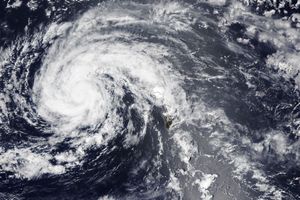
The third (bottom left) image was taken at 8:02 UTC March 6th as Gafilo wasapproaching the coast of Madagascar and shows a tropical cyclone atits most mature, intense stage. The storm now has a very tight, verysmall eye with a nearly perfectly symmetrical eyewall containing anear-uniform concentric ring of intense rain rates (dark reds). Thestorm is now at Category 5, and the winds are at 140 knots (161 mph).The final image (bottom right) shows Gafilo in the Mozambique Channel after thestorm had crossed the entire northern half of Madagascar. Taken at7:47 UTC on the 8th, with the circulation having been disrupted byland and topography and its supply of water vapor essentially cutoff,the eye is now totally gone with no visible eyewall present. A largerainband with a broad area of intense (dark reds) to moderate (greenareas) rain remains, extending from the central part of the MozambiqueChannel eastward into western Madagascar north of the storm's center.Gafilo had now been downgraded to a tropical storm with remaining windsestimated at 55 knots (63 mph).
TRMM is a joint mission between NASA and the Japanese space agency JAXA.
References & Resources
Images produced by Hal Pierce (SSAI/NASA GSFC) and caption by Steve Lang (SSAI/NASA GSFC).