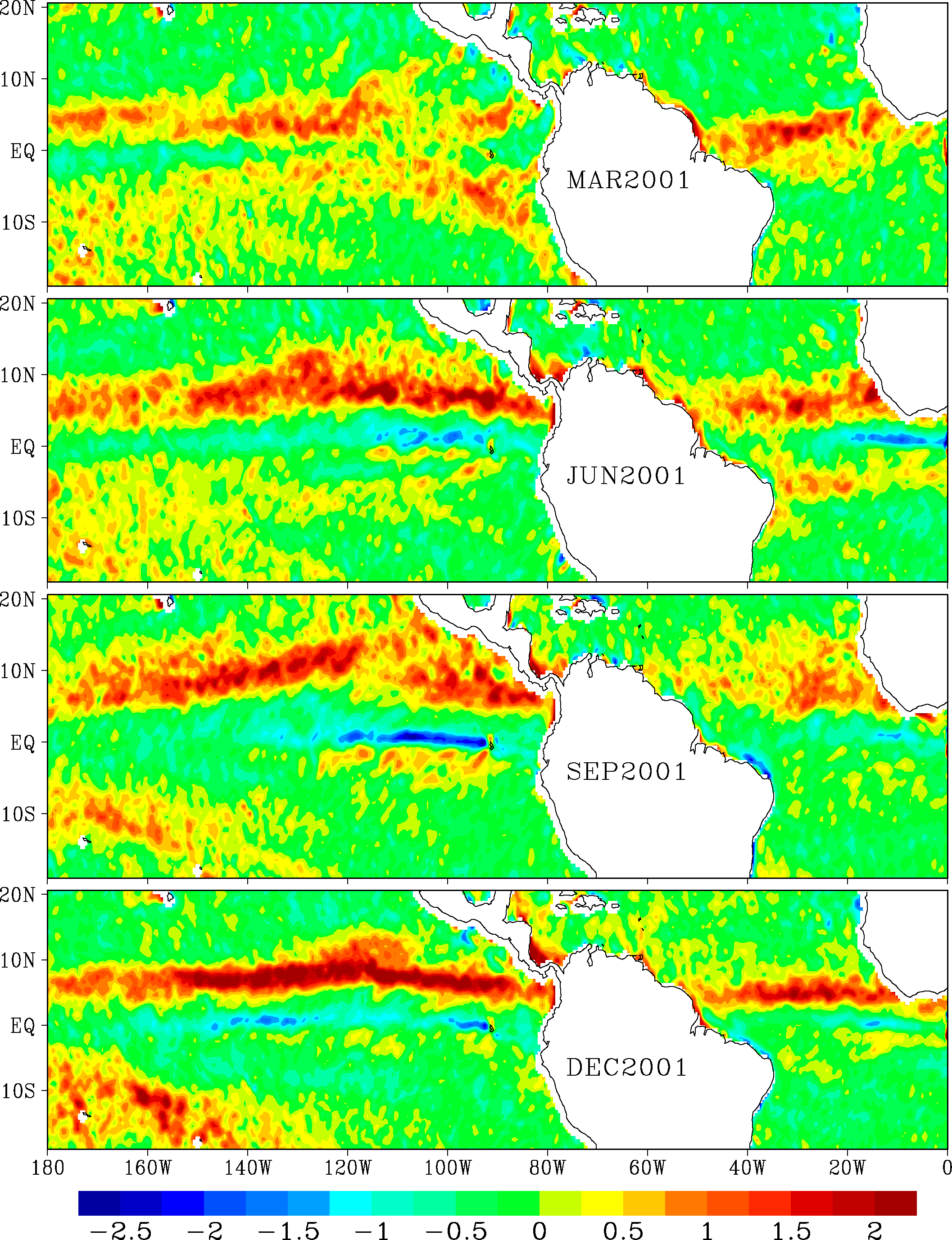














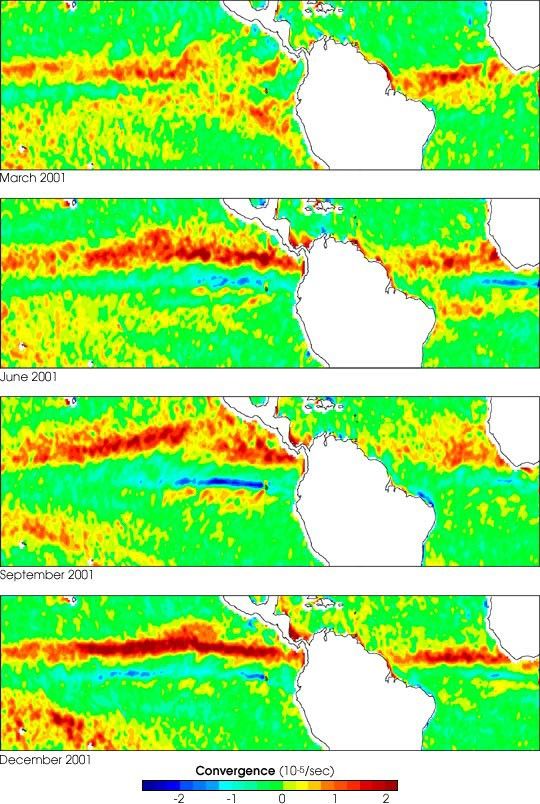
NASA’s QuikSCAT satellite has confirmed a 30-year old largely unproven theorythat there are two areas near the equator where the winds converge year afteryear and drive ocean circulation south of the equator. By analyzing winds,QuikSCAT has found a year-round southern and northern Intertropical ConvergenceZone. This find is important to climate modelers and weather forecasters becauseit provides more detail on how the oceans and atmosphere interact near theequator.
The Intertropical Convergence Zone (ITCZ) is the region that circles theEarth near the equator, where the trade winds of both the Northern and SouthernHemispheres come together. North of the equator, strong sun and warm water ofthe equator heats the air in the ITCZ, drawing air in from north and south andcausing the air to rise. As the air rises it cools, releasing the accumulatedmoisture in an almost perpetual series of thunderstorms. Satellite data,however, has confirmed that there is an ITCZ north of the equator and a parallelITCZ south of the equator.
Variation in the location of the ITCZ is important to people around the worldbecause it affects the north-south atmospheric circulation, which redistributesenergy. It drastically affects rainfall in many equatorial nations, resulting inthe wet and dry seasons of the tropics rather than the cold and warm seasons ofhigher latitudes. Longer term changes in the ITCZ can result in severe droughtsor flooding in nearby areas.
“The double ITCZ is usually only identified in the Pacific and AtlanticOceans on a limited and seasonal basis,” said Timothy Liu, of NASA’s JetPropulsion Laboratory and California Institute of Technology, Pasadena, Calif.,and lead researcher on the project. In the eastern Pacific Ocean, the southernITCZ is usually seen springtime. In the western Atlantic Ocean, the southernITCZ was recently clearly identified only in the summertime.
However, QuikSCAT’s wind data has seen the southern ITCZ in all seasonsacross the entire Atlantic Ocean and the eastern Pacific. “QuikSCAT’s wind dataconfirms there is a double ITCZ, and that they exist all year long,” Liusaid.
This is a major find for the science community, as the existence, location,and seasonality of the double ITCZ had remained controversial since 1969.
full text: Satellite Sees Double Zones of Converging Tropical Winds around The World
For more about convergence zones, read: TheIntertropical Convergence Zone and Convergence Zones: Where the Action Is
References & Resources
Image courtesy Liu and Xie, NASA JPL