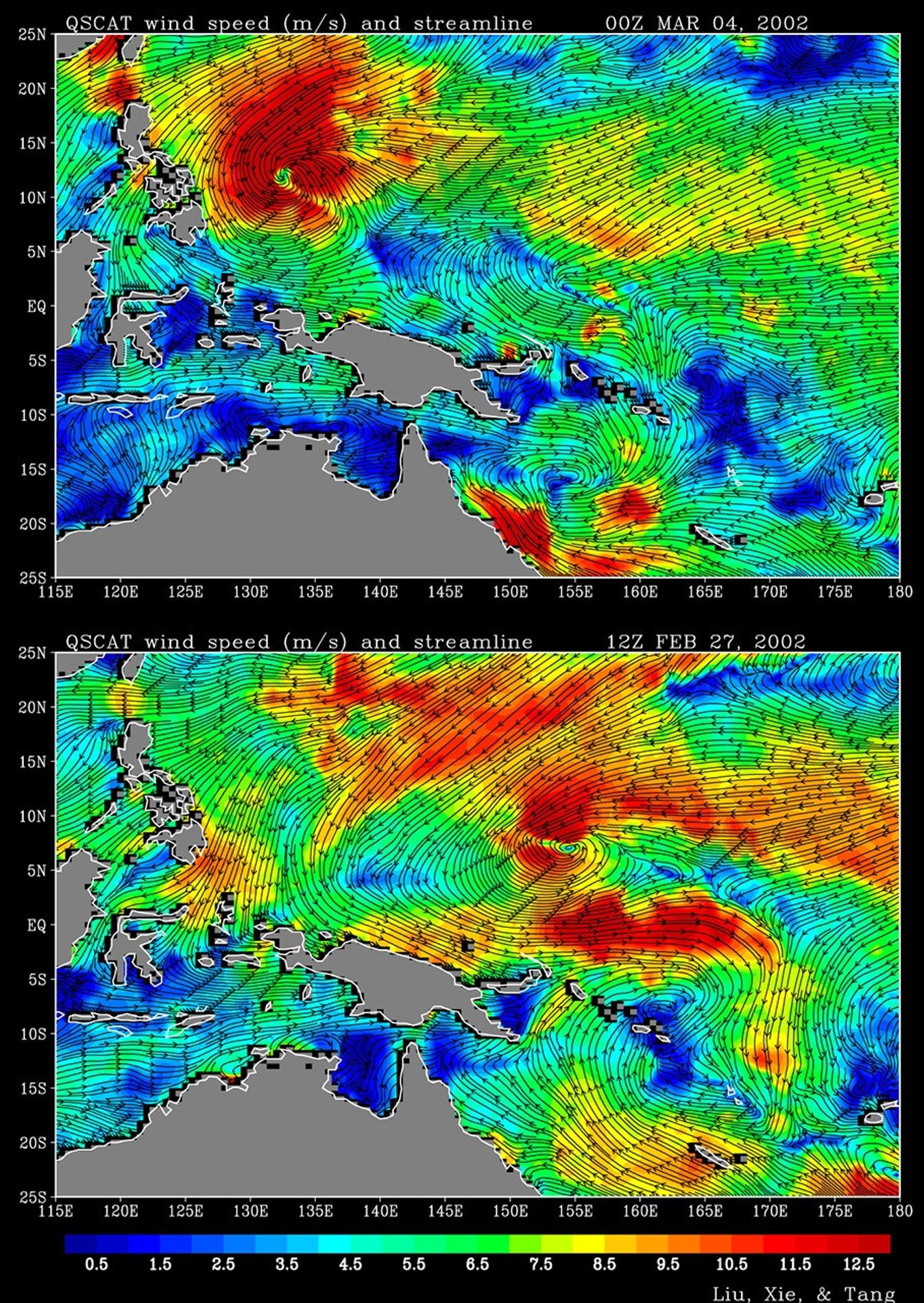












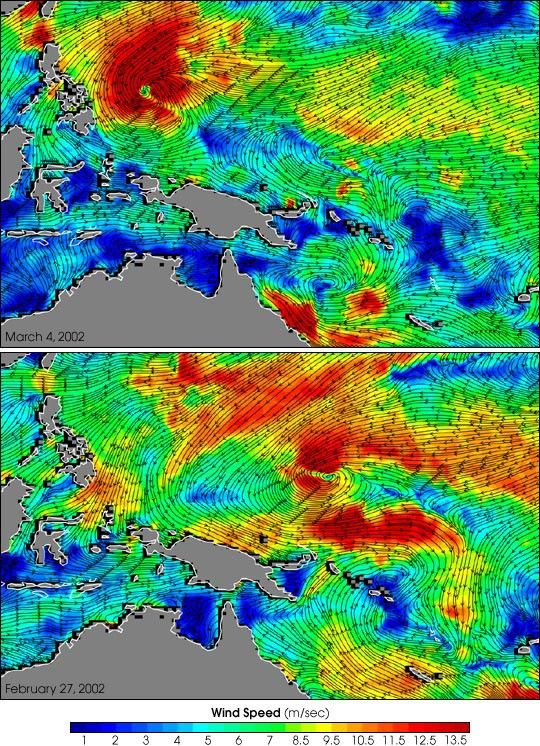
QuikSCAT, a NASA satellite instrument that measures winds, observed a strong typhoonthreatening the Philippines on March 4, 2002, (top) unusual in the winter season, and asimilar tropical cyclone passing along the Australian coast towards Nuomea.These unusual phenomena are results of the westerly winds (blowing fromIndonesia towards the American coast) along the equator which started back inFebruary 25, (lower) as QuikSCAT revealed. Color in these images relates to wind speed, arrowsindicate direction.
The reversal of the usual Trade Winds (which blow from the American coasttowards Asia) generally triggers Kelvin waves (warm surface water that movesalong the equator from Indonesia to the coast of Peru) and twin cyclones, which areearly indicators of El Niño. The equatorial westerly winds generate a counter-clockwise vortex in the Northern Hemisphere and a clockwise vortex in theSouthern Hemisphere. The Trade Winds push warm water from east to westacross the Pacific, reaching the American coast in one to two months.The increase in frequency and strength of the Kelvin Waves may lead toEl Niño. Strong westerly winds and twin cyclones werealso observed by QuikSCAT during last Christmas season (2001) and the Kelvin wavetriggered at that time reached South America in Early March 2002.
References & Resources
Images courtesy Liu, Xie, and Tang, QuikSCAT Science Team