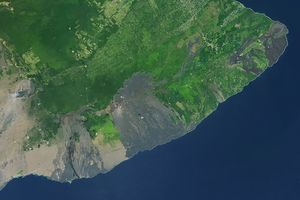
















A lava-filled pit set inside Kilauea’s Halema‘uma‘u Crater continues to emit a plume of steam, ash, and sulfur dioxide. The pit, located in the southwestern wall of Halema‘uma‘u (itself a crater in the larger Kilauea Caldera) first opened on March 19, 2008. Volcanic emissions have continued almost uninterrupted since, punctuated occasionally by violent explosions of ash and fragments of rock torn from the crater walls. On September 5, 2008, scientists at the Hawaii Volcano Observatory (HVO) discovered a lava lake inside the pit.
This natural-color satellite image was acquired on March 19, 2010, by the Advanced Land Imager (ALI) aboard NASA’s Earth Observing-1 (EO-1) satellite. At that time, the HVO was reporting sulfur dioxide emissions at the summit of 500 metric tons (1,100,000 pounds) a day—compared to an average of 140 metric tons (310,000 pounds) a day from 2003–2007.
The plume’s bluish tinge distinguishes it from the clouds that cover much of Kilauea’s summit. The blue color is caused by tiny droplets of sulfuric acid, the product of chemical reactions that occur when sulfur dioxide mixes with air. The HVO reported that the ash in the plume was primarily composed of spatter, indicating it was derived from fresh lava.
References & Resources
- Hawaii Tribune-Herald. (2010, February 28). Kilauea’s plume: now you see it, now you don’t. Accessed March 24, 2010.
- Hawaii Volcano Observatory. (2009). 2007–2009 Hawaiian Volcano Observatory daily update. Accessed March 24, 2010.
- Hawaii Volcano Observatory. (2009). 2007–2009 Kilauea eruption timeline. Accessed March 24, 2010.
NASA image by Robert Simmon, using ALI data from the EO-1 team. Caption by Robert Simmon.